
INTERVIEW: Stateless individuals are focus of new play ‘Liberty Scrap’
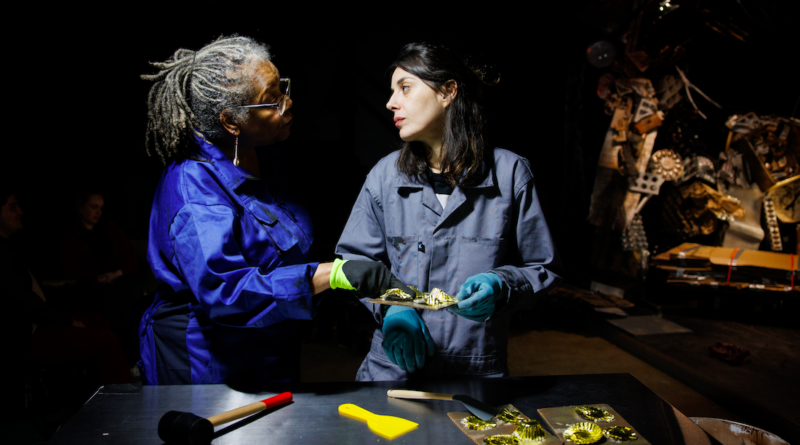
Photo: Liberty Scrap is a new play by Christina Masciotti. Photo courtesy of Maria Baranova / Provided by Everyman Agency with permission.
Liberty Scrap, the new play from Guggenheim fellow Christina Masciotti, recently finished up its run at Culture Lab LIC in New York City. The show examines the difficulties faced by stateless individuals in the United States.
The main character in Masciotti’s show is called Katya, who works in a scrap metal warehouse, but whose dreams lie in the art world, according to press notes. She is a sculptor, someone who sees beauty in the debris left behind at the warehouse. The most impactful challenge she faces is her immigration status and how it prevents her from visiting her ill father.
Recently Masciotti traded emails with Hollywood Soapbox and opened up about the world-premiere production, which was directed by T. Ryder Smith. Questions and answers have been slightly edited for style.
Liberty Scrap feels very much of the moment. Do you feel that this play speaks to 2026?
Yes, even though the play is set in 2015, it speaks to so much of what we’re seeing unfold right now. The shifting immigration landscape, policy reform, ICE enforcement [Immigration and Customs Enforcement], human rights violations, and the legal challenges to the 14th Amendment. When I started writing the play, I never anticipated birthright citizenship would be at risk in the United States by the time it premiered, but what I hope the play offers is a chance to slow down and take in what’s happening in a deeper way through these characters.
What came first when writing the play: the story, the main character, the issue being explored?
The main character has to come first for me, or I have nothing to say. The story stems from the person. This person, Katya, happened to be confronted with the mind-boggling issue of statelessness — where the general, relatable feeling of not belonging or feeling invisible is amplified to absurd proportions. She’s told her birth certificate isn’t recognized where she was born, so, for all intents and purposes, she doesn’t exist. She has no way to obtain a legal form of ID, which severely circumscribes what she can do with her life, and she’s unable to travel when her family needs her most. How does that light a fire in her? How is she transformed in the pressure-cooker of these circumstances? The story I was interested in writing tracks her growth.
What goes through your mind before a world premiere? Nervousness? Excitement?
When I was younger, sheer terror. It’s evolved to alternating layers of nerves and calmness because there’s a lot to worry about, but there’s also a lot that’s out of my control. I know I’ve done my best in writing the script, and that’s my contribution. Typically, I know the cast is exceptional, and I trust them to take the reins each night. For this production, Natia Dune brings so much depth and complexity to Katya — the emotional fury, fragility, heart and soul. Patricia R. Floyd, as her mentor, Maxine, lights up the room with irrepressible joy and wisdom. I just hope that amidst all the variables, the essential intentions of the play find a way to come through and resonate.
Stateless is a term some people may be unfamiliar with. How would you define it?
I would define it as not having access to citizenship anywhere in the world. The formal definition is not being considered a “national of any country.” The thing is, even after being acquainted with the definition, it’s hard to fully understand what it means. How can a person be denied citizenship anywhere in the world, including the country where they were born (and in many cases have never left), as well as any country where they may have emigrated? How can the two paths by which citizenship is granted — by soil (wherever you were born) or by blood (through ancestry) — both be closed off with no recourse, indefinitely? It flies in the face of the idea that citizenship is naturally bestowed upon any law-abiding person.
If your citizenship is revoked, or you’re unable to obtain it, it garners suspicion: You must have done something wrong, broken some law, entered a country illegally. When, in reality, some form of arbitrary exclusion is the driving force — pushing out certain groups of people who were never welcome. It was important to convey this through all the characters that surround Katya — that her situation is not just a quirk of fate — but an ongoing problem with long a history in the United States and all over the world.
I’m grateful to have the presence of the Chorus to help convey this and embodied in this production by such compelling and distinctive performers: Danny Borba, Taylor Hadsell, John Hagan, Dayo Olatokun and Rasha Zamamiri.
Is the work pure fiction, or is it based on a narrative you came across?
It is a work of fiction rooted in real experiences. The writing process began by listening to personal accounts of real people grappling with statelessness and looking for the recurring themes. Family separation was a big one, and it was something that I connected with through my own experiences of being cut off from family members overseas. So I added details from my own life to fill in the outlines. If the play is successful, a wide range of people will feel it is their story and see themselves in it.
Often the media defines stateless individuals by their connection to work, but you allow space to consider the art they create as well. Could you describe Katya as an artist?
Katya’s artistry reflects how she lives her life in many ways: one ingenious improvisation after another. She takes discarded material and reassembles it into forms that can be better appreciated. Her specialty is insects — a class of life that is itself typically overlooked, stepped on or stepped over. In her father’s words, she “brings them from the bottom to the up so people can see.” That’s who she is as an artist, a visionary, unwilling to accept the ways she’s been made small by the world.
By John Soltes / Publisher / John@HollywoodSoapbox.com
Liberty Scrap by Christina Masciotti recently ran at Culture Lab LIC in New York City. Click here for more information and tickets.