
INTERVIEW: Persian classical music comes alive at NYC’s Town Hall
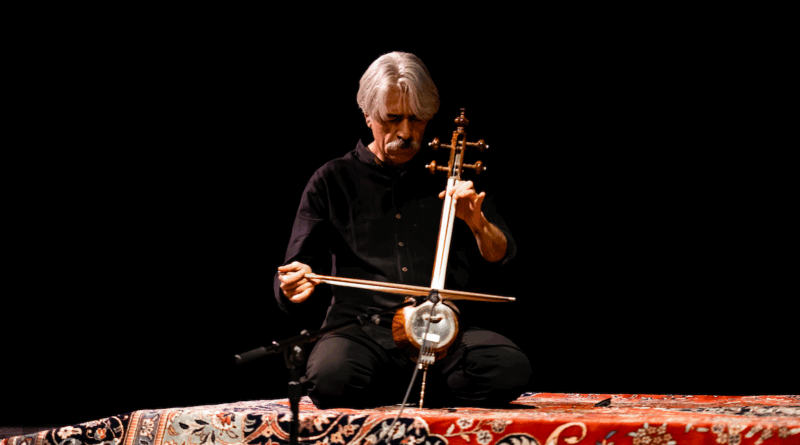
Photo: Iranian musician Kayhan Kalhor will play The Town Hall in New York City, Nov. 30. Photo courtesy of Nima Nazemi / Provided by Cindy Byram PR with permission.
The Town Hall in New York City will soon play host to a special performance of Persian classical music, courtesy of Kayhan Kalhor, a world-leading player of the kamancheh, a spiked fiddle. For New Yorkers, this is an extremely rare chance to see and hear a maestro at work in an intimate setting. The performance is set for Nov. 30, and joining Kalhor for the evening of music will be Kiya Tabassian on setar and Behrouz Jamali on tombak.
Kalhor’s accomplishments are numerous. First off, he’s a Grammy Award winner, but he’s also worked with some of the best musicians and ensembles in the business, including Masters of Persian Music, Dastan Ensemble, Yo-Yo Ma’s Silk Road Project, Indian sitar maestro Shujaat Husain Khan, string quartet Brooklyn Rider, Turkish baglama virtuoso Erdal Erzincan and Malian kora master Toumani Diabate, according to press notes.
Kalhor’s collaboration with Ma has been particularly well-received. Their recent project together is a new commission called “Venus in the Mirror,” which premiered this past summer in Germany.
Recently Hollywood Soapbox exchanged emails with Kalhor, who is considered Iran’s foremost composer and musician, to learn more about his art and what audiences can expect in Midtown Manhattan. This will be first time in more than a decade that he’ll play New York City. Questions and answers have been slightly edited for style.
How would you describe the kamancheh? What type of instrument is it?
The kamancheh or spike fiddle is the ancient, bowed string instrument of Iran, and ancestor to most bowed instruments throughout Asia and Europe. It has a small hollowed belly made of walnut or mulberry wood with a thin stretched skin covering and a conical shaped neck. The modern kamancheh has four strings, generally tuned in fourths or fifths, and is held vertically. Its sound is reminiscent of the human voice.
When did you first learn about Persian classical music? Does it go back to your childhood?
I began my musical studies at the age of 7 under Master Ahmad Mohajer. I was a child prodigy on the kamancheh and was invited at the age of 13 to work in the Iranian National Radio and Television Orchestra, where I performed for five years. At 17, I began working with the Shayda Ensemble of the Chavosh Cultural Center, the most prestigious arts organization at the time in Iran. While performing with Shayda, I continued studying the Iranian classical repertoire (radif) with different masters. In 1978, I went to Rome to study Western classical music and continued my studies at Carleton University in Ottawa, Canada, where I received a degree in music.
What do you think sets Persian classical music apart from other genres and traditions?
What sets Persian classical music apart is its deep intertwining of poetry, emotion and improvisation. Persian music is rooted in the ancient dastgah system — modal frameworks that serve as both scales and musical landscapes. Each dastgah has its own melodic motifs (gusheh), emotional mood (hal), and associated times of day or spiritual states. Each performance is spontaneous, and the subtle microtones, melodies, and poetry — often associated with Sufi poets — invite the musician and listener into a shared space of reflection and transcendence. Persian classical music also employs subtle intervals between Western semitones, giving it a rich palette of emotion and “color” that Western ears may hear as fluid or hovering between notes. Persian music is listened to as an inward journey — an act of reflection, meditation and transcendence.
What has it been like collaborating over the years with Yo-Yo Ma?
Yo-Yo and I met over 20 years ago and have become close friends and musical partners. I love him like a brother and look forward to every opportunity to work with him. He is special beyond words.
It’s been more than 10 years since you offered a New York City concert. Did the pandemic delay your return?
The pandemic did not play a significant role in not having a major NYC tour but rather my non-stop touring schedule outside the States and finding the right venue for my music. I love The Town Hall and feel it is the perfect venue for this concert!
What’s it like working with Kiya Tabassian and Behrouz Jamali?
Kiya and Behrouz are like family to me. They are very sensitive artists who I have known for a long time and have deep respect for.
By John Soltes / Publisher / John@HollywoodSoapbox.com
An Evening of Persian Classical Music: Kayhan Kalhor will be presented Nov. 30 at The Town Hall in New York City. Click here for more information and tickets.