
INTERVIEW: ‘Medea of the Laundromat’ returns to NYC
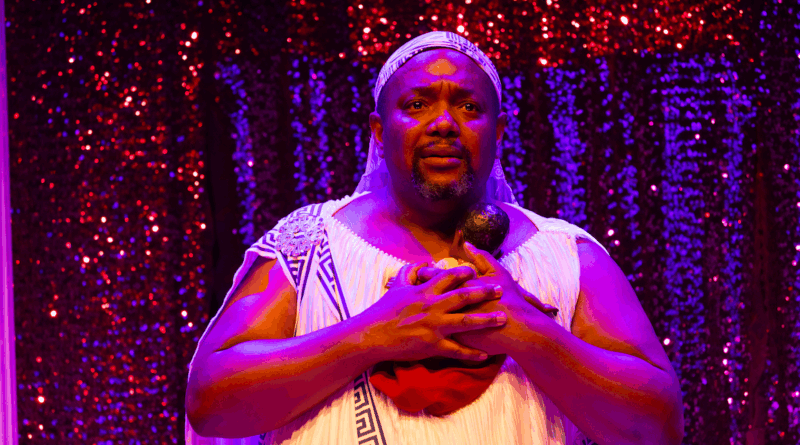
Photo: Medea of the Laundromat stars John-Andrew Morrison. Photo courtesy of Bronwen Sharp / Provided by Everyman Agency with permission.
One of the most exciting theater entries on the cultural scene right now is the revival of the landmark play Medea of the Laundromat, this time directed by Arthur Adair. Performances of the H.M. Koutoukas show continue through Sunday, June 22, at La MaMa’s The Club, but all remaining dates appear to be sold out.
At the center of the play is Medea, portrayed by Tony Award nominee John-Andrew Morrison. He is joined by fellow cast members Jason Howard and Jenne Vath. Together they bring renewed life to the words of Koutoukas, who was a prolific writer, rule-breaker and legend of the downtown theater scene. His life, from 1937 to his death in 2010, spanned the ups and downs of the 20th century, and Medea of the Laundromat is one of his most well-known and campiest shows. He was often referred to as the godfather of off-off-Broadway.
Recently Hollywood Soapbox exchanged emails with Adair to learn more about the production. He has directed a number of important plays over the years, including Alfred Jarry’s Ubu Roi, William Shakespeare’s A Midsummer Night’s Dream, Euripides’ Bacchae, Sophocles’ Oedipus and Eugene O’Neill’s The Emperor Jones, among others. Questions and answers have been slightly edited for style.
Do you feel that this production honors the history of this important work, or are you trying to discover new ground?
While we do honor the work, the spirit of the Coffeehouse, and the founding of off-off Broadway, there is also the responsibility to communicate the intent of the piece through the lens and sensibility of the 21st century. From Wendell Stone’s fascinating journey, “Caffe Cino: The Birthplace of Off-Off-Broadway”: “H.M. has said that all of his ‘things are shredded’ after performance. According to his friend and fellow playwright Robert Heide, ‘Koutoukas has always hesitated to publish his works because he wrote for a specific moment and does not wish to allow publication to freeze them in time or to remove them from the context for which they were written.” Our intention with the production is to commune with the work and serve as an instrument for it to live and resonate with a contemporary, yet universal, audience, the result of which is a work that perhaps may convince Harry to not want to shred it or set it on fire.
What do you personally like about the piece?
I feel most at home working in the classical theatre and Theatre of the Absurd; I love decoding structure, deciphering metaphor and reassembling it into a whole greater than the sum of its parts. This piece offers me the opportunity to exist within both worlds. I am entranced by the sensuality of the language, the depth of vulnerability and thought. As Harry explained, “If you want to get wild or campy, you need the strength of the classical structure. Then your teapots can have nervous breakdowns.”
I find the work arresting. Personally, I believe, H.M. was working through professional conflicts within the state of theatre through the story of Medea. By 1965, the no-holds-barred exploration the Coffeehouse provided since 1958 was being interpreted/formalized as a movement, a reaction against the Broadway and off-Broadway models; while art does thrive within limitations, classification or definition can confine and stifle. As so often happens, sub- and counterculture is co-opted by the popular culture, and with it comes success, or the desire for success, which oft compromises the art — an age-old cliché but a journey that exists for all artists. I believe, through the piece, we are placed within Harry’s struggle with this and his final realization and self-actualization. I do believe it is his greatest work because it is his most personal work.
Where are we in the world? Greece? A laundromat? A coffeehouse?
Yes, this is one of the exquisite joys of the piece, Harry’s ability to transcend time and space in the construction of the work. The production attempts to match that feat. Yes, Harry provides us with the setting of a laundromat in the royal palace in the ancient city of Corinth, Greece, but the language and action of the characters suggests, at times, they are in classical era and at others, in real time, which for Harry was 1965, but for us, 2025. The intention of the production attempts to take that one step further and place the audience within a 1960s Coffeehouse. However, this was compromised, slightly, most notably by rules and regulations in 2025, to keep us safe, as well as the current socio-economic climate. We did manage to bring back late-night theatre, 10 p.m., but in 1965, the start times were 11 p.m., midnight and sometimes a third performance at 1 a.m.
How important was H.M. Koutoukas to the history of downtown theater?
Most would agree that Harry is the godfather of off-off-Broadway. I offer he is only second to Joe Cino in importance, and even with that, Joe provided the space/resources, Harry the content/style. So for me it’s a match. If we are speaking about the importance of the founders of downtown theatre, we must include Ms. Ellen Stewart as the number one and the MaMa of us all.
Robert Patrick: “One who extended the bounds of dramatic imagination, and without whose exuberant example the world would never have been ready for Harvey Fierstein or Charles Busch or The Rocky Horror Picture Show, was H.M. Koutoukas, who I consider our finest playwright since Tennessee Williams.”
What’s it like working with this ensemble of actors?
I came up in La MaMa in ’97, so for me, the concept of producing theatre is a familial undertaking in a home where we come together to share stories. Most of the company, myself, actors, light and costume designers have been working together for just about 20 years now. We have the late, La MaMa Resident Director George Ferencz to thank for bringing us all together through his founding of The Experiments Play Reading Series in 1998, which presented works from La MaMa’s earliest years — known as the Pushcart Catalog. We, the company, were longtime performing members of the series and became known as The Experimentals. This 2025 production would not exist without George.
What is the state of indie theater? Is it night and day compared to Koutoukas’ time?
Theatre is dead! Or so it has been said for centuries. There’s an immediacy to that sentiment I enjoy; it provides a sense of purpose for the work. “Good” theatre is purposeful and can only be achieved by those who genuinely care about its health — the stewards of the art form. The state of the theatre is ever-evolving, from the time of fires in caves through today’s multimedia presenting complexes. As long as contemporary stewards are taking action, theatre will always be living, and in so, dying.
By John Soltes / Publisher / John@HollywoodSoapbox.com
Medea of the Laundromat, written by H.M. Koutoukas and directed by Arthur Adair, continues through Sunday, June 22, at La MaMa’s The Club. Click here for more information and tickets.