
INTERVIEW: Marc Bamuthi Joseph on the ‘creative horizon’ of Black theater
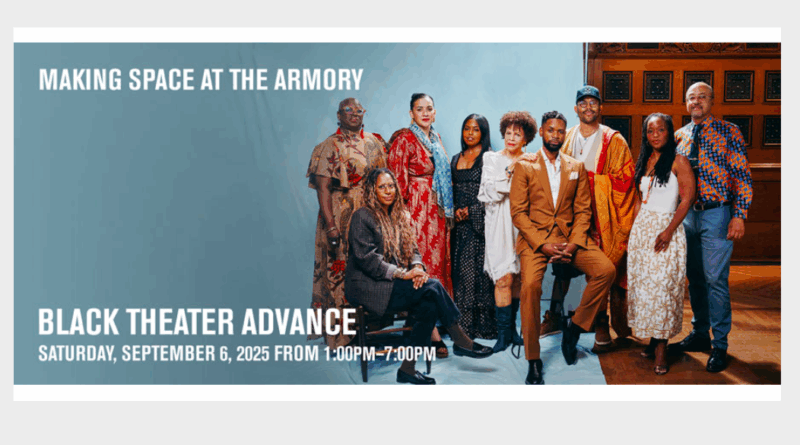
Image courtesy of Park Avenue Armory / Provided by official site.
The Park Avenue Armory and National Black Theatre are set to host a one-day event called Black Theater Advance on Saturday, Sept. 6. The programming for the day, which takes place at the Armory, will include engaging conversations with producers, singers and actors who will be exploring the creative horizon and future of Black theater in the United States and around the world.
There are many powerful voices who have signed up for the special event, including Dr. Mary Schmidt Campbell, Nikkole Salter, Ebony Noelle Golden, Nicholas Ryan Gant, Jordan E. Cooper and Jonathan McCrory. One of the most exciting features is a fireside chat between Kamilah Forbes, executive producer of the Apollo Theater, and Marc Bamuthi Joseph, spoken word artist and writer.
“I think that there’s a need for creative intelligence to gather,” Bamuthi said in a recent phone interview. “There’s a lot of energy I think that is being spent on legislative policy and dealing with doom, but I think we all benefit when we’re doing something more than trying to contend with doom. We all benefit when creative people are coming together to imagine a beautiful future, and so that is what’s going to happen on Saturday. … There are folks coming together through the lens of the National Black Theatre, through the lens of Park Avenue Armory, folks like Jordan Cooper, who I think represents the future of American theater and American performance. … It feels likes Black folks coming together to have a very broad conversation about the American creative horizon.”
Bamuthi, a TED Global Fellow and Emerson Collective Dial Fellow, said he is particularly excited to enter into a conversation with Forbes, who is one of his longtime friends and what he described as a “dynamic producer.” To describe the impact of Forbes, Bamuthi used the words “brilliant” and “kind-hearted,” and he is most impressed with the changes she’s led at the Apollo.
“This is a person that comes out of an extraordinary intellectual lineage as well as being a pioneering producer and director herself,” said Bamuthi, a member of the American Academy of Arts and Sciences. “One of the many things that I think the two of us have in common is that we are practicing artists who have been executives at major cultural institutions, and that’s the approach that we’re going to take, how we can not just think about our artistry as what we put out on stage, but think about the artist intellect and how that lives and breathes in contemporary contexts.”
For their conversation, Bamuthi is interested in digging deep and trying to find some tangible takeaways on not just content, but also creativity itself. In his mind, focusing too much on the content can feel static. Instead, he wants to explore the art of making art as a generative practice.
“Creative people are always going to be generative, and I think that is just in the nature of the vocation,” he said. “But also humans are going to want to imagine, and there isn’t such a thing as historical stasis as it relates to art. There’s always going to be somebody that’s going to hum a new tune. There’s always going to be someone. Even if this all came down right now, there’d be some human with a stick in dirt trying to get an idea out of their head, so that’s just the nature of art and artistry itself.”
Bamuthi added: “We’ve reached the moon, and there are endless amounts of people that are striving for Saturn. There’s always something to build on according to the historical achievement, and I think that’s very much the ethic of what we’re seeing at this gathering and among artists. There’s no time to rest.”
One topic that Bamuthi would like to focus on is the idea of energetic reciprocity and how Black artists are part of a powerful cultural lineage.
“There is definitely call and response,” said Bamuthi, who is also a librettist and cultural strategist. “[Forbes and I] were both born and raised at the same time that hip hop and hip-hop culture was born and raised. … We are firmly in the class of voters, in the class of parents, in the class of grandparents, in the class of political leaders that were born into a culture of energetic reciprocity, and so we want our audiences to respond to that ethic and culture as well. And we want our cultural institutions to continue to do things that drive that reciprocity, that call and response, that implication, so that audiences aren’t just there to witness; they are there to be implicated in the action itself.”
By John Soltes / Publisher / John@HollywoodSoapbox.com
Black Theater Advance, featuring Marc Bamuthi Joseph and other artists, will take place Saturday, Sept. 6, at the Park Avenue Armory in New York City. The Armory and National Black Theatre are co-curating the programming. Click here for more information and tickets.