
INTERVIEW: Indigenous people of northern Mexico inspire ‘Packrat’
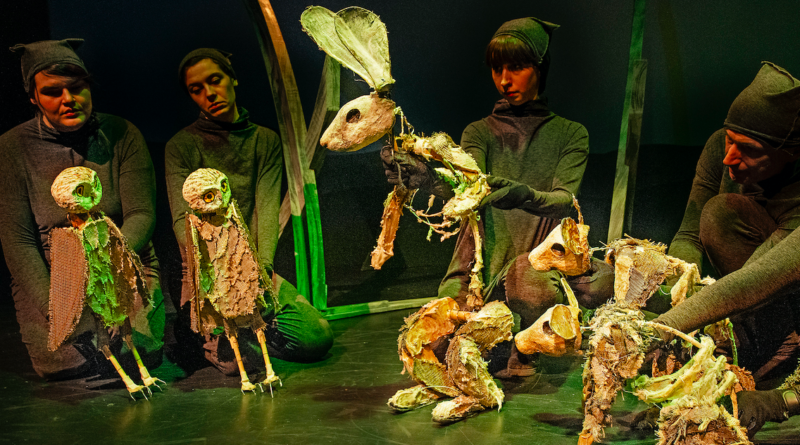
Photo: Packrat: The Quest por la Abundancia tells a story of global displacement and climate change, using puppets. Photo courtesy of Stefan Hagen / Provided by Everyman Agency with permission.
Packrat: The Quest por la Abundancia is a new play featuring puppets written and directed by Renee Philippi; its world premiere, courtesy of Concrete Temple Theatre, will run Jan. 7-23 at Dixon Place in New York City. The show is inspired by many issues that are impacting global populations, especially Indigenous cultures. Some of those topics include home, displacement, climate change and the need to respect ancestral knowledge.
Specifically, Philippi was influenced by the Comcáac, an Indigenous people of northern Mexico, according to press notes. From their history and traditions, the playwright crafted a tale of how one takes care of a community and takes care of the planet. All of this is brought to wondrous life thanks to puppets designed by Carlo Adinolfi, who serves as co-artistic director of Concrete Temple Theatre with Philippi.
Recently Hollywood Soapbox exchanged emails with Philippi to learn more about the world-premiere show and her creative process. She has been in the theater business for more than three decades. Questions and answers have been slightly edited for style.
When did inspiration first strike and you put pen to paper?
In April 2024, Carlo (co-artistic director, Concrete Temple Theatre) and I had a very poignant experience, Residencia Escena Cross-Border XEPE 2024. The residency took place from April 25-29 in Hermosillo, Bahía de Kino, and Punta Chueca, in Sonora, Mexico, during the Xepe a Cöicoos and World Music Festival. The festival is organized and ran by the Seri, an Indigenous people who are self-governing in Punta Chueca. (http://isc.gob.mx/devel/festivales/festivital-xepe/).
There, we worked with artists from Hermosillo and Punta Chueca. The residency is the result of a collaboration between Concrete Temple Theatre and Contenidos Artísticos (https://www.contenidosartisticos.com/), an organization dedicated to the curation and production of performing arts projects that often emerge from the community. During Residencia Escena Cross-Border XEPE 2024, I met with Rene Montaño, Comcáac linguist and elder, several times. Soon after this experience, I put pen to paper.
How does the work showcase Indigenous knowledge when telling its story?
Rene shared with me many things about his culture, from traditions to what he felt were the most challenging concerns facing the Seri (Comcáac) people. I focused on what he thought were the greatest challenges facing the Seri, as they are also currently the challenges all people in all places are facing: the need for leaders who are stewards and working to preserve our resources and lands for the future.
Would you say the target audience are younger theatergoers?
No, I would say the target audience is an adult audience and then a family audience. The play is meant to be accessible to all people, but the target audience is an adult audience.
What’s it like collaborating with Carlo Adinolfi?
Carlo is a dear soul, and it is a privilege to collaborate with him. There is a great deal of give and take and space. Carlo is born in Italy, while I am Italian American. We often joke about Italians loving Italians — and that it works because of the Italian thing. We have different skills: Carlo is a designer and performer while I am a writer and director. Carlo’s internal rhythm is much dreamier than mine; I tend to charge ahead, a little sped up. We balance each other out.
Do you believe dreams can help guide us on our life’s journey?
I was raised in Flint, Michigan, and my mom was a single parent with five kids. She was always deeply spiritual and passed that along to us. I have always believed in a spirit world and that our ancestors can communicate with us through dreams. So, I feel a kinship with Rene and the Seri people, in terms of dreaming and staying connected to those who have come before us.
How does puppetry elevate the performance? For example, why not create this show without puppets?
The show’s characters are animals. Bud, a packrat, is the star of the show, and he is joined by Especial (a Spanish giant rabbit) and Amoz (a jackrabbit from Punta Chueca). There are then other characters, but these three represent three different cultures coming together: United States, Mexican and Seri (or Comcáac). The puppets and the personification of place/culture through the animal softens everything. It helps to take the preachiness out of the work. The animals live in nature, and its destruction impacts them directly. It is a matter of life and death for them.
By John Soltes / Publisher / John@HollywoodSoapbox.com
Packrat: The Quest por la Abundancia, written and directed by Rene Philippi, runs Jan. 7-23 at Dixon Place in New York City. Click here for more information and tickets.