INTERVIEW: Get into the mind of Hamlet like never before
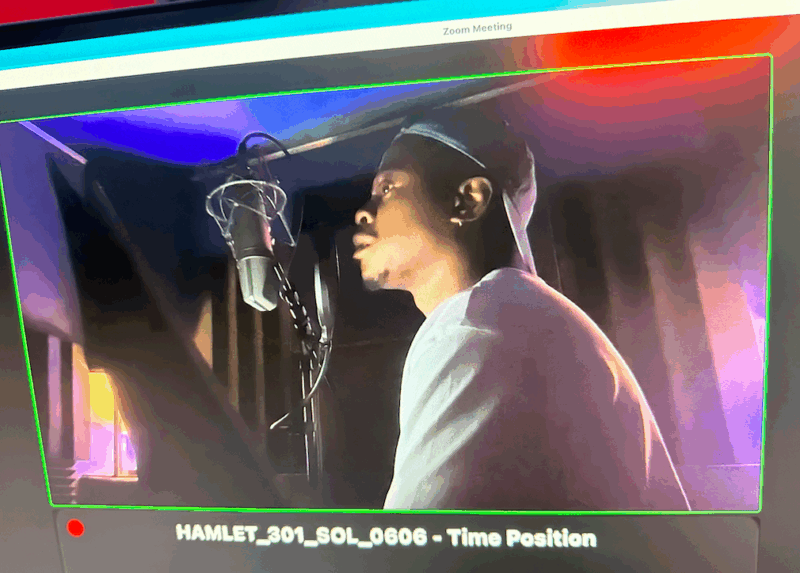
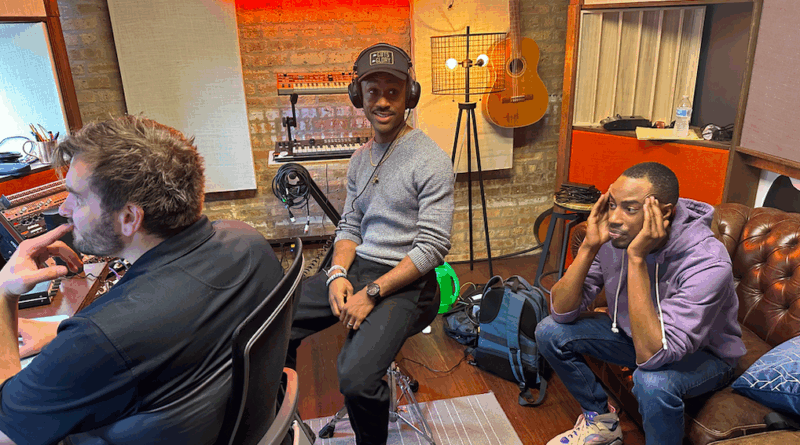
Photo: The cast and creative team of Hamlet brings William Shakespeare’s tragedy to life in audio-drama form. Photo courtesy of Make-Believe Association / Provided by BBB with permission.
Hamlet, for all intents and purposes, can be considered the most famous play of all time. William Shakespeare’s sprawling epic of a show has graced stages around the world for hundreds of years, and it’s often seen as the ultimate role for an actor to tackle.
Throughout its history, Hamlet has been staged in many different formats, taking place in many different time periods and brought to life in many different versions. The Make-Believe Association, preeminent purveyors of audio storytelling, has decided to bring the Danish prince to audiences via podcast form. The company’s new adaptation of Hamlet, starring Daniel Kyri in the title role, is billed as a “revelatory audio drama,” with all episodes now available on podcast platforms.
“When we were working on our previous project, Lake Song, an audio drama series, I had the realization that when we listen to audio dramas on headphones, the voices are not coming from a screen, they’re not coming from the stage,” said Jeremy McCarter, who adapted and directed this audio Hamlet. “They’re right there inside our heads, which gives audio storytellers a real superpower, and if we have this ability to sort of put the audience inside the mind of a character, then the question became: Who would be the most interesting head to go inside? And for lots of reasons, the answer was Hamlet, so from there, it then became adapting the script and building the cast and doing the sound design and everything else. But it really grew out of that thought about this special ability that we have.”
This Hamlet, which also includes original music, needed to be presented in a different way than staged versions of the play. The audio drama essentially has listeners get into the mind of the title character, which meant McCarter needed to comb through the text and only include scenes in which Hamlet was present.
“I will say that I set myself this rule at the very beginning that I wasn’t going to add a word,” he said. “I would take the words that come from Shakespeare’s scripts, of which there are three major varieties of Hamlet, and I would cut and assemble and reassign. But none of it would be original to me. A term that we used for the approach was ‘radically faithful,’ where clearly this is a strong new take on Hamlet, but it’s one where we want to be as rigorous and faithful as we can to the source material.”
The process of adaptation called on McCarter to build a composite version of the script that would still tell the overall story coherently. He rid the text of scenes that Hamlet did not appear in, but then he needed to figure out a way to still convey the important details of those excised scenes.
“What that took was figuring out what the audience would need when Hamlet isn’t on stage and then using Shakespeare’s words to create those moments dramatically, so, for example, we know that he goes to visit Ophelia, not because we see it on stage, but because Ophelia describes the encounter to Polonius a couple of scenes later,” the director said. “So using that description, it was possible to reconstruct the scene, so it was a lot of that. I have to give a lot of credit to James Shapiro, a Shakespeare scholar and friend of mine from when I was on the artistic staff at the Public Theater. When this was in a very early stage, and I had just a draft of this that I felt comfortable sharing, I asked him to take a look to let me know if the Shakespeare police were going to arrest me for this, and he was enthusiastic about it. And that really kept me going for a long time as we tried to figure out all of the play’s puzzles.”
When McCarter continued his creation of the audio drama, he came to realize his initial inclination was a correct one. There is so much interiority for this character that it was somewhat easy to get into his mind and hear his thoughts, which is perfect for a listener who has earbuds in and is following the character slowly come undone.
“Why is it the most famous play ever written,” McCarter asked. “Because vividly and viscerally, Shakespeare tells us what’s happening in his mind, and so it felt like going farther in the direction that Shakespeare was already going. Still, it was a giant experiment. We did not know at many junctures if it was going to work at all. … Is the plot going to be coherent because there’s some important stuff that happens when he’s off-stage? How do we make Elsinore feel real to the audience if all they’re getting is sound? We can’t show them the way people are setting traps for Hamlet, so all of these things we did our best. And we held our breaths, and so it’s been gratifying and a big relief lately to see the way people are responding.”
McCarter, who is the founder and executive producer of the Chicago-based Make-Believe Association, prefers to call the company’s creations audio dramas rather than podcasts. Though technically they are podcasts and will appear in people’s feeds on their phones.
“These days, what does podcast even mean anymore,” he asked. “I read stories that podcast is now becoming synonymous with chat show, so this is clearly not one of those. To me, from the very beginning of the Make-Believe Association back in 2017, I thought audio drama is not some exotic departure from doing plays on stage. It just feels like the kind of work you do on stage, only with the dials turned all the way up.”
McCarter added: “So on stage you’re hoping to engage the imaginative faculties of the audience to fill in the pictures. … With audio drama, it’s that. It’s the exact same challenge, but you give yourself many fewer tools to achieve it. And those restrictions I think force us to be inventive and just really deliberate about things like clarity of storytelling. We know that if we lose people, it’s really easy to flake off at an audio drama and go listen to music or something else.”
By John Soltes / Publisher / John@HollywoodSoapbox.com
Hamlet from the Make-Believe Association is now available in podcast form. The series is adapted and directed by Jeremy McCarter. Click here for more information.