
INTERVIEW: Chris Gabo’s ‘Surgeon’ play receives world premiere in NYC
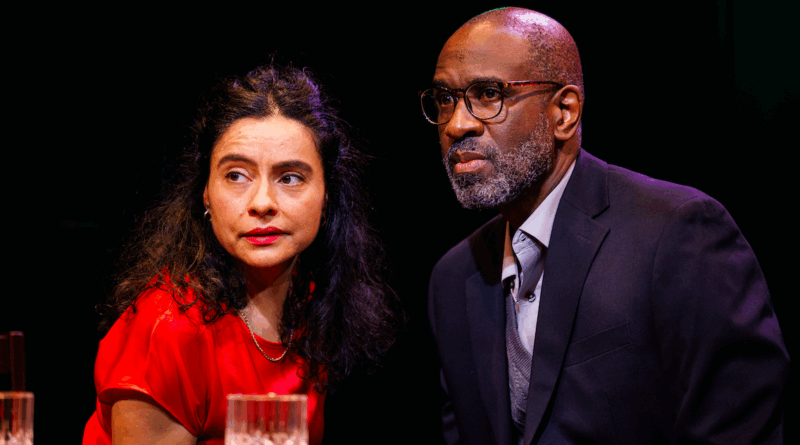
Photo: The Surgeon and Her Daughters stars Liza Fernandez and Brian D. Coats. Photo courtesy of Maria Baranova / Provided by Emily Owens PR with permission.
The Surgeon and Her Daughters, the new play by Chris Gabo, continues at Theater 154 in the West Village of Manhattan. Performances of the piece run through Dec. 20.
The show, directed by Adrienne Campbell-Holt, is presented by the Colt Coeur theater company in honor of its 15th anniversary. The play depicts the events surrounding the disappearance of a United States Marine sergeant major and how her daughters must navigate the unanswered questions that have surfaced in the wake of their mother’s absence, according to press notes.
Gabo is a playwright and rap artist from Tampa, Florida, who earned an advanced degree in playwrighting from Yale University, where he trained with Tarell Alvin McCraney, according to the writer’s official biography. He has made a name for himself with some high-profile projects at HBO, including a set of episodes for the series In Treatment.
Recently Gabo, a Colombian American artist, and Hollywood Soapbox exchanged emails about The Surgeon and Her Daughters, which is partially inspired by the playwright’s own family and set in New York City. Questions and answers have been slightly edited for style.
How long has this show been in development?
I started writing The Surgeon and Her Daughters 10 years ago. The first reading was at my apartment in Astoria, Queens, with Russell G. Jones and Liza Colon Zayas as the leads when I was like 25. After that I got into the Cherry Lane Mentor Project, and as far as I was concerned, that was like getting signed to Roc-A-Fella in ’98. Cherry Lane is where I met Adrienne Campbell-Holt. After that I got into the Ojai Playwrights Conference, the Emerging Writers Group at The Public and then the Yale School of Drama, and at each of those institutions I continued to develop this play.
How closely does the play track with the story of your parents?
My father — Fernando Alberto — famously planted a rose bush in front of my mother’s window, and I always knew that that was going to be the act break before intermission. But other than that, it’s fiction. Both my parents immigrated to Queens from Colombia when they were in their teens. My mother became a doctor; my dad became an immigration defense attorney. The stories my father would bring home were a lot of the inspiration for the piece. One of the most common tragedies we would often discuss was that cats would come over here and not be allowed to continue the professions they built in their homelands. This is most common with the medical professions because medical accreditation usually doesn’t transfer over, so that’s how you get a surgeon who ends up handing out flyers at a bar.
The phrase “the weight of inheritance” is used to describe the play. Could you describe what this phrase means to you?
To me, the weight of inheritance just means, you know, playing the cards you’re dealt.
How is music used in this play?
In Los Angeles, I am blessed to work with a lot of incredibly talented musicians. The dudes I work with most often are two gentlemen, Jesse Singer and Chris Soper, who go by the group name Likeminds. They have this gorgeous vintage room and specialize in 1970s and 1960s textures. They make most of the live instrumentation in my rap records, but lately we’ve gotten into a rhythm scoring my little indie movies.
Colt Coeur gave me a budget to create the interstitial music for The Surgeon and Her Daughters with them, and then, when I wanted to expand the palette for the play, I realized that I had a hard drive full of stems from years of sessions with them and that the emotions in my music were the same as the emotions in the play, cuz, you know, they’re mine. From there, our genius sound designer, Salvador “Suavecito” Zamora, began to use the music not just as interstitial music but also to underscore key moments of the play.
There is a moment in the piece where we use my song “Government Name” produced by the big homie Richie Beretta as a song playing out of a car that Kana Seiki, the actor playing Ashley, dances to drunk in the street. The pre-show music is my new EP Bad With Money, produced by Richie Beretta. The intermission music is more Likeminds instrumentals and one demo that I’m singing over, and the curtain call song is an unreleased joint called “Good Light,” also produced by Likeminds and mixed by the big homie Ebonie Smith.
How is your career in rap music going? Does music bring you artistic fulfillment?
My mentor Dave Kutch, who I met while I was working with The Weeknd, is the esteemed mastering engineer of some records you might’ve heard of, Lemonade, Stankonia, After Hours, Summertime ’06, among many others. He’s the one who introduced me to Likeminds, Richie and Ebonie. The past two years he’s been encouraging me to hibernate and focus on the sonics. He was like, “Bro, you write movies, plays and novels. The lyrics are there, but I need the music to have as much drama as the words. I need you to take us on a three-act journey sonically before you even put pen to paper.”
So, I took that advice and started working with a higher caliber of musicians and producers and started working at honoring the sounds that were in my head. The first expression of the last two years is my EP Bad With Money — go stream that! — and in 2026 I’m dropping a six-song EP quarterly.
My next big leap is combining my love for plays and music into one container. That container is a play called Hollywood and Gower that I’m writing for my ex-girlfriend, dear homie and fellow traveler Kara Young who apparently has like mad Tonys now. It’s an epic straight play. It’s not a musical, but there is a corresponding album that I’m making simultaneously. And there are songs in the play that affect the narrative. Hollywood and Gower is a love story about broken rock ‘n’ roll dreams and how those dreams shatter and reunite families and lovers.
What’s the theater scene like in Tampa, Florida?
So, I can’t speak to what the scene is like now cuz it’s been a minute since I was there, but I got into playwriting because Florida has the largest high school thespian community in the country. We compete at district, state and national levels the way that sports do, and we compete in every category. Now, you could probably picture in your head what that looks like when it’s kids doing scenes and monologues, but the playwriting competition is wild cuz you literally go into a room with all of your friends and teachers and stand as a seated panel of judges tells you how much they loved or hated your play.
The first three years I got superiors. The fourth year, I got a phone call. They were like, “Hey, uh, we’re not adjudicating this play on the grounds of obscenity unless the teacher and the kids parents stand behind the play.” Luckily, my parents and teacher did stand behind the play. Then when we got adjudicated, they didn’t let any of my classmates enter, so it was just me and my teacher standing in a room with a panel of judges telling us that they didn’t read past the first page because they found the language so offensive.
The next day I called Silver Meteor Gallery, a theater across the train tracks from Ybor City — the historic Tampa neighborhood where all the clubs are that I would play rap shows at — and I rented the Silver Meteor Gallery to produce my play that all the judges hated. Silver Meteor was like 60 seats, with a backstage, and you could rent it for $300 a month. And, uh, yeah, that’s where I produced my first play. All the kids who would come to my rap shows came to the play, and the St. Pete Times reviewed us. It was pretty punk rock.
Last night, at the second preview of The Surgeon and Her Daughters, my homie Creature — incredible emcee and the frontman of the best band in New York City, Rebelmatic — came to see the play, and I got mad emotional cuz I was like, this is history repeating itself in the flyest way possible.
By John Soltes / Publisher / John@HollywoodSoapbox.com
The Surgeon and Her Daughters, written by Chris Gabo, continues through Dec. 20 at Theater 154 in the West Village of Manhattan. Click here for more information and tickets.