
INTERVIEW: Carolina González Valencia tells the story of her mother in debut film
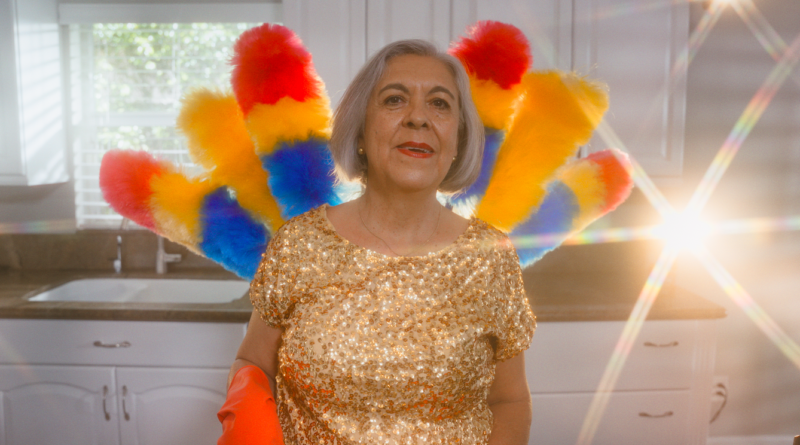
Photo: How to Clean a House in Ten Easy Steps features the director’s mother, Beatriz Valencia. Photo courtesy of Cinema Tropical / Provided with permission.
Carolina González Valencia has made an extremely intimate and personal movie for her debut feature-length film. How to Clean a House in Ten Easy Steps, which premiered at the True/False Film Festival a few weeks ago, is an interesting amalgam of documentary and fiction, depicting the story of the director’s mother, Beatriz Valencia, as she moves from her native Colombia to the United States to become a domestic worker, and then back again.
In today’s environment, where immigration policies are debated on a daily basis in Washington, D.C., the story of Beatriz and Carolina is a powerful one, showcasing the difficulties of moving between countries and how families are tested throughout the process. Press notes indicate that the film is centered on the themes of displacement and dreams, labor and empancipation.
Recently Hollywood Soapbox exchanged emails with González Valencia about her debut feature. Her previous work has touched upon the forms of animation, video, film, performance, writing, drawing and painting. Questions and answers have been slightly edited for style.
When did you first get the idea to make this film?
In 2016, I began researching domestic labor in the United States, driven by a desire to understand my mother’s work and its impact on our family. However, I was haunted by a central question: How could I honor the work she does without letting her occupation become the defining trait of who she is as a person? I wanted to create a film about my mother that refused to represent her as a victim and defined by her job as a domestic worker, as is often the case in documentaries. Instead, I sought to create a space for experimentation and play — a space where we could explore representation on our own terms.
The heart of the film emerged from a simple prompt I gave my mother: “What would you be if you weren’t cleaning houses?” Her answer was “a writer.” From there, we began a series of “rehearsals” — games with the camera designed to remove the pressure of performance and center my mother’s big personality and humor. We pretended she was a world-famous author and I was a journalist; through this fiction, we found a surprising honesty. It became easier to navigate difficult, real-life conversations about our immigration from Colombia when we were “playing pretend.” This sparked the motor of the film: using fiction not to mask reality, but as a tool to become more real.
Would you call this a documentary or a fictional film or something in between?
I’m very interested in cinema and in challenging what we call “nonfiction” or documentary films. I believe that at the moment you decide to place a camera anywhere and hit record you are already constructing reality. Every film no matter its genre is a construction. In consequence, instead of defining my film or the documentary genre within a set of strict boundaries, I’m more interested in the opportunity to question and play with those boundaries, to blend them, make them fuzzy, gray just like the human experience is. Also, I love the opportunity to push against the legacy of nonfiction film, which is a legacy that is very tied to colonialism and Eurocentric ideas and processes of representing “the other.” I am excited about a cinema where we mix things up, where we create new ways for collaborations in front and behind the camera, blur all boundaries, and hopefully with that see ourselves and our stories in new exciting ways.
Are domestic workers and immigrants respected in 2026 in the United States? Does the film open up a window to understanding their important work?
It’s heartbreaking to answer this question. Immigrants are particularly vulnerable right now and disrespected. In many places in this country, it is dangerous to take your kids to school, or to go to work, or go to grocery store or even to have an accent. We cannot normalize what is happening; it is dangerous and not OK. Domestic workers, nannies and care workers are particularly vulnerable right now and directly targeted. I hope the [film] creates connection between our story and yours (whoever you are). Also, I would like to celebrate us and help to function as an antidote for so much hate by focusing on the love we feel towards each other. The film focuses on our greatness and beauty, and not because we’re perfect, or the work we do, but because we’re humans full of wonderful complexities.
For me, respect and dignity are not conditional. Human respect is not conditional on a document or work success. I believe in plurality and collective action. Right now, in this country, there are many people working really hard to defend immigrants’ rights from different parts of our society. There are people on the ground, working on public policy, in schools, in hospitals, in the government or protesting on the streets. All the contributions matter. I believe in that, in our collective power. What we all, as individuals, bring to the table [are] our own unique skills and voices. Some of us contribute as cultural workers. I bring stories to the surface; I create connections, inspired by our joy and wonderful humor. I will keep creating to make sure we keep laughing and dancing in sequins and in community as our radical antidote in a moment that some want us to disappear.
Why 10 chapters as opposed to another number?
The structure of the film is built around “The 10 Steps,” a format that originated when I asked my mother to write the essential steps to clean a house. While the title plays with the tropes of self-help books — which often ignore the structural inequalities facing immigrants — it eventually became the framework to explore the complex conditions of her life. To build this world, I invited our “chosen family” of fellow immigrants, along with my brother and aunt, to join the improvisation. Together, we constructed the myth of the famous writer, her world tours and her awards. Though these elements are fictional, the act of writing was real; my mother wrote every word she narrated, reclaiming her identity through the very act of creation.
Was it important to document the impacts of aging? That topic is not always represented on film.
I think it’s very important to create stories that talk about aging from different perspectives, especially from the perspectives of our many intersectionalities. In my opinion, many times in film, the conversation about class is often ignored or not complex enough. Class, race, gender and immigration status affect very differently the journey of aging. In addition, in this country, where there is so much emphasis on the nuclear family and individualism, elders and families are also more vulnerable when they don’t have a network of support. This is particularly true for immigrant families.
How is your family doing today?
My mother is back in Colombia. She took care of my stepdad, Pepe, until he passed away last July. Alba also moved back to Colombia. Gina is currently in law school, studying to be an immigration lawyer. I’m very proud of her. Leonor is well, taking care of her two kids and many of her family members that came from Venezuela. And finally, I am still in Maine fighting the long winters.
By John Soltes / Publisher / John@HollywoodSoapbox.com
How to Clean a House in Ten Easy Steps, directed by Carolina González Valencia, recently played the True/False Film Festival. Click here for more information.