
INTERVIEW: Anti-obscenity laws, erotic fiction are focus of ‘Dirty Books’
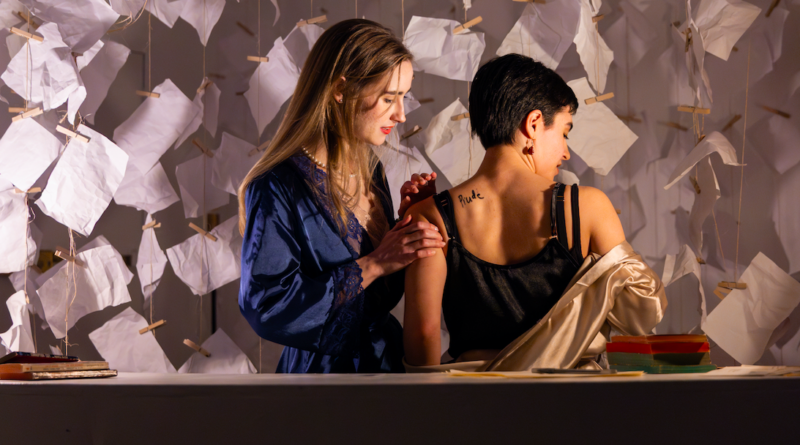
Photo: Dirty Books stars, from left, Alexis Pratt and Melina Rabin. Photo courtesy of Bjorn Bolinder / Provided by DKC O&M with permission.
The new immersive play Dirty Books follows the lives and careers of writers who constantly were hitting up against the anti-obscenity laws in the United States, circa the 1960s. They were writing erotic stories, but their output needed to be secreted away, in hidden bookstores and underground businesses, according to press notes.
Dirty Books arrives in New York City thanks to Mara Lieberman, who is credited as creator and director. Her company, Bated Breath, is presenting the extended run, which continues through Feb. 28. Previous work for Lieberman includes Voyeur: The Windows of Toulouse-Lautrec, Chasing Andy Warhol, Unmaking Toulouse-Lautrec, Beneath the Gavel, Freedom: In 3 Acts, The Pride of Christopher Street (co-written with Jamie Roach) and Wild Things, according to her biography.
Recently Lieberman exchanged emails with Hollywood Soapbox and shared details on the creation of the theatrical piece. Questions and answers have been slightly edited for style.
Have you been delighted and surprised by the success of Dirty Books and the extensions?
I’m not surprised, but I am deeply delighted. In my experience, the work I make tends to build through word of mouth over time. I remember Unmaking Toulouse-Lautrec at Madame X during a stretch when audiences were steadily growing. There was a moment when the room felt full of people who looked like kids on Christmas morning: They knew something special was about to happen, even if they didn’t know exactly what. That feeling didn’t arrive overnight; it emerged because the show had been given time to find its audience.
What delights me most about Dirty Books is that I get to watch a highly articulated piece of theater, infused with a sense of play, meet an audience that’s ready for it. You can feel it in the room, and you see it in the way people come back and bring their friends.
I’ve come to think of opening a show like opening a restaurant. Momentum takes time. If you owned a restaurant, you wouldn’t close your doors because you didn’t sell out in the first few months. If you stay audience and experience focused and are willing to buck some of the old ways of doing things, momentum builds in a way that can be magnetic.
When did inspiration hit you for this play?
The initial idea dates back to 2018, when I was thinking a lot about how to bring audiences together in a communal way. I became intrigued by the idea of an audience collectively writing an erotic story, which immediately felt both thrilling and a little insane. I first imagined it happening in a bar and thought, “This is bound to end in a bar fight.”
That fear became productive. Worrying about how quickly something playful could go off the rails pushed me to look for a structure that could hold the room without killing the fun. Thinking about censorship and the anti-obscenity laws writers were working under turned out to be surprisingly helpful. It led to the invention of a controlling figure — a kind of 1950s gym teacher with a whistle — who can rein things in, redirect the energy, and take the wind out of bad behavior in a way that’s funny and effective.
Then COVID happened, and a piece involving audience-centered erotic writing understandably went on the back burner. The real ignition came later, after I returned from La MaMa Umbria’s Directors Symposium. My colleagues sat me down and said, “It’s time to do the projects you’ve been marinating for years. Do the scary thing. Do Dirty Books.” That was when I set a date and cast the show. One of my teachers, Tina Landau, used to call that moment “exquisite pressure.” That’s exactly what I needed.
How is the play immersive, and what level of intimacy is added by going this route?
While the play takes place in a non-traditional space, the immersion in Dirty Books is less about set design and more about how the audience experiences time and story. From the moment they enter, the usual relationship between audience, actors and space is already disrupted. They find themselves in a very specific environment, and then that environment begins to shift. So it feels less like watching a play and more like moving through a journey.
The intimacy comes from how the piece engages the audience’s curiosity and attention. There’s a sense of play and a little bit of voyeurism, but also a feeling of being involved rather than managed. The structure invites people to be present without being instructed what to think or feel. Contemporary realities are present without being hammered home, and whatever personal or societal resonance emerges is allowed to surface on its own.
Did you always have plans to direct the play as well?
Yes, always. The way I think about making theater doesn’t draw a hard line between writing and directing. In some forms of theater-making, those distinctions can get in the way of a cohesive vision. I think of it more like composing a piece of music — you’re shaping a whole experience.
That’s been the process for all of our shows since I took over the company in 2013. I was influenced early on by European models of theater-making, often described as “auteur” directing, where writing and directing are understood as a single creative engine. At the same time, the process needs balance. In order to achieve that, I build in a devising period where there’s freedom and play with the Bated Breath ensemble where everyone can generate material and immerse themselves in the world of the piece.
From there, my role is to bring my own vision and pre-devising work as a maker to what’s been generated — allowing the material, the collaborators, and the research to inform and inspire the final form.
What do you think this historic tale has to say about society in 2026? Are book bans the modern-day equivalent of anti-obscenity laws?
I used to believe, or at least hope, that society was moving in a broadly forward direction: toward greater freedom of expression and respect for difference. What’s been most shocking to me is realizing how cyclical these struggles are and how quickly restrictions can return and become normalized.
In many ways, contemporary book bans feel even more alarming than historic anti-obscenity laws. What’s striking now is how openly and casually books are being removed (many of them texts I read in school) and how little justification is offered beyond vague claims of protection or impropriety. The clear motivator here is power. Stories that center marginalized voices or even simply refuse to conform to a dominant narrative pose a threat because they resonate so widely.
Dirty Books is autobiographical in that sense. The piece moves between personal stakes and historical forces, following a character whose inner life unfolds alongside shifting social mores. By letting those timelines exist side by side, the show asks how much has really changed.
What would you say is the goal of Bated Breath Theatre Company?
The goal of Bated Breath is ultimately about aliveness. Through the work, I want people to feel that they matter — not in an abstract way, but concretely, in the room and in the moment. I want to leave behind a body of theater that offers startling aesthetic experiences of life in the present and that invites people to feel, think, and reflect on history and their place within it while they are actually living it.
Formally, that means veering away from strict naturalism and leaning into metaphor, physical storytelling, immersive environments and participation. Those choices aren’t decorative. They are a way of interrupting passivity and inviting play as a serious human act.
By John Soltes / Publisher / John@HollywoodSoapbox.com
Dirty Books, created and directed by Mara Lieberman, continues through Feb. 28 at Bated Breath Theatre in New York City. Click here for more information and tickets.