
INTERVIEW: 1920s jazz comes to life at Birdland
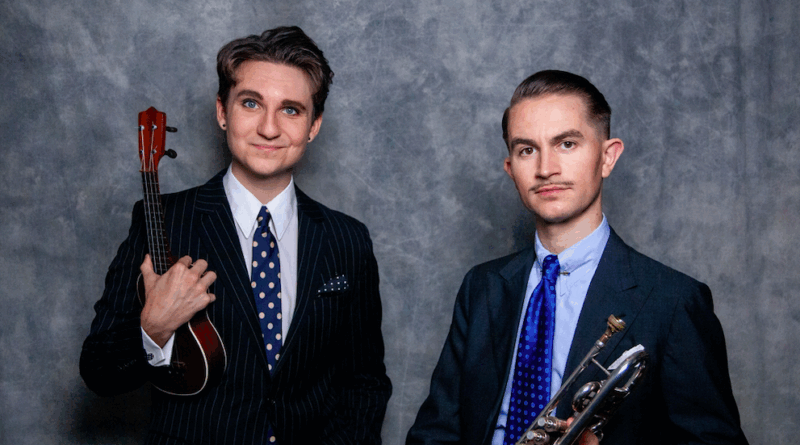
Photo: From left, Bryce Edwards and Mike Davis will bring their new show, Hot Combination, to the Birdland Jazz Club, Sept. 1. Photo courtesy of Stephen Mosher / Provided by Fortune Creative with permission.
Bryce Edwards, a vaudevillian troubadour, and Mike Davis, an accomplished cornetist, are in the time-travel business. Well, not technically, but heading back approximately 100 years is what they plan to do at the world-renowned Birdland Jazz Club on Monday, Sept. 1. That’s when they’ll be premiering their new show, Hot Combination, which is a tribute to the 1920s jazz greats Red Nichols and Cliff Edwards.
Joining the two musicians at Birdland will be Ricky Alexander on reeds, Josh Holcomb on trombone, Felix Lemerle on guitar, Dalton Ridenhour on piano, Jay Rattman on bass saxophone and Colin Hancock on drums, according to press notes.
At the show, one can expect a little bit of humor mixed in with the music because that was the order of the day when Nicholas and Cliff Edwards took to the stage. Cliff, a most unique performer, was known as much for his ukulele playing as he was for his “mouth trumpet,” both of which will be recreated on Sept. 1. Heck, maybe there’ll even be an homage to Cliff’s later-in-life creative endeavor: voicing Jiminy Cricket in Pinocchio.
Recently Hollywood Soapbox exchanged emails with Davis and Bryce Edwards (no relation to Cliff). They both have many credits to their name, including playing at Jazz at Lincoln Center and clubs all around the country. Questions and answers have been slightly edited for style.
When did you first fall in love with early jazz music?
EDWARDS: I was first exposed to this music by my grandfather, Robert Fogarty. The first voice I ever heard sing the songs of Cole Porter, George M. Cohan and Gershwin was his. I really connected to these songs, and I learned them inside and out. This was before I was 10, definitely. This eventually caused me to go down the rabbit hole of early recording artists like Eddie Cantor and Jolson and eventually the early crooners. I became obsessed with jazz after my grandfather introduced me to the 1924 sessions of Bix Beiderbecke and the Wolverines. The rest is history.
DAVIS: Records alone didn’t click for me until I heard a live band playing 1920s-style jazz, with no gimmicks, no amplifiers, just music, the way it was played and presented without irony. That opened my eyes to what the records do and don’t capture, and once I could extrapolate what the instruments really sounded like, records came to feel like I had been let in on a secret, and playing music still feels like I’m letting the audience in on it.
What can audience members expect at Hot Combination?
EDWARDS: Despite how The Cliff Edwards/Red Nichols Project may sound, this is not an academic exercise! These records are so fun and infectious, and that energy really still holds up. Really, it’s just great music played by a really great band (truly, I’m so thrilled to be with these guys. It’s an all-star group of guys who really know their onions), and, of course, I’ll be singing my head off. The material is a great blend of jazz, Tin Pan Alley, vaudeville — everything that I love. It’s really a wonderful and authentic slice of music from 100 years ago.
DAVIS: Hot Combination has something for everyone. For the jazz fan, deep cuts, meticulously transcribed from the records but performed with a depth of familiarity with the music of the time that makes them feel fresh. For the cabaret fan, a bouquet of obscure songs (and a few familiar favorites) full of refreshing lyrics and some rather risqué moments. And for the average Joe, the genuine enthusiasm of a world-class jazz band playing great music!
Do you feel that Red Nichols and Cliff Edwards receive the credit they deserve?
EDWARDS: Of course I’m going to say no, but I’m very biased! Cliff Edwards is an odd case because he gets very little name recognition these days, and yet when you say he voiced Jiminy Cricket in Pinocchio, just about everyone can conjure up his performance in their head. In that role, he created something really timeless that resonates across generations, but at that point he had already been in show business for more than two decades, and during that time (in the ‘twenties’20s especially), he was a pioneering artist. In this era he introduced the world to songs like “Fascinatin’ Rhythm” and “Singin’ in the Rain.” His approach was always personable, dynamic and at times very intimate in a way that you simply did not hear from his contemporaries in the days before electric recording. In a way, he laid important groundwork for the first microphone crooners (who really got the ball rolling for all subsequent pop singers) before anyone was singing into a microphone. That being said, Edwards had a wholly unique style that is completely his own, and a large part of that was his strong jazz leaning. Edwards embraced jazz more wholly and more successfully than just about any other commercial pop vocalist in the ’20s. He’s one of the first people to be recorded scatting, and though his approach may sound odd to the modern ear, vocal improvisation was a mainstay of his style. But probably most importantly it’s just really fun music, even today.
DAVIS: Cliff Edwards is best remembered for having voiced Jiminy Cricket, but his early records are well worth enjoying for his masterly vocal technique and jazz feel on the ukulele, especially during the acoustic era, singing and playing into a metal horn in order to be recorded. Red Nichols, one of the most in-demand studio players of the Jazz Age, often gets short shrift from the jazz establishment for his clean playing in complex arrangements, but deserves greater recognition as a hot improviser and creative voice.
What’s it like collaborating with each other?
EDWARDS: I love working with Mike. We’re both obsessed with the same obscure stuff. Where a lot of people will think of this era in terms of a monolithic style, Mike is really in tune with how truly diverse the sound of jazz was in the ’20s. He recently played with my trio and the Gotham Jazz Festival, and our set really ran the gamut of different styles from 1917-1932. Mike plays to each so specifically but always plays in his own voice. I especially appreciate how inspired he is by the players that have sort of been forgotten and how he is bringing so much of their language back into the conversation of jazz because that’s essentially what I’m attempting to do in the cabaret world with the vocalists of the era.
DAVIS: Bryce and I both find inspiration in the records, as well as the biographies, of the people who made them, and are moved to create music like they did. While hopefully we’ll manage to stay out of speakeasies and away from bathtub gin, we’re both of the mind that they were onto something in those days, and repeating their creative process is the path we’d like to follow. The music speaks for itself and doesn’t require updates or gimmicks.
What’s it like performing at Birdland?
EDWARDS: I don’t think it should come as a surprise that I love performing at Birdland. Not only is it an honor to continue musical tradition at this historic and iconic venue, they treat the artist well. I have a good relationship with the wonderful Birdland staff. You get folks running sound and tech that take a lot of care with what they’re doing. Would that every venue were like Birdland!
DAVIS: Birdland is New York’s premier jazz club and the ideal venue for this show. While other clubs neglect their equipment and pack tourists in like sardines, Birdland’s first-rate gear, excellent sound engineers and comfortable atmosphere make it the perfect place to enjoy jazz in style, with food and drinks for grownups in a room that sounds good. It’s as simple as that!
What’s next after this Sept. 1 concert?
EDWARDS: Well, my regular joint the Frivolity Hour is returning to Birdland Sept. 17.
DAVIS: We can’t spill the beans now, but wouldn’t it be fun if we recorded this music?
By John Soltes / Publisher / John@HollywoodSoapbox.com
Hot Combination featuring Bryce Edwards and Mike Davis will play Monday, Sept. 1, at Birdland Jazz Club in Midtown Manhattan. Click here for more information and tickets.