
INTERVIEW: Elevator Repair Service dives into ‘Ulysses’
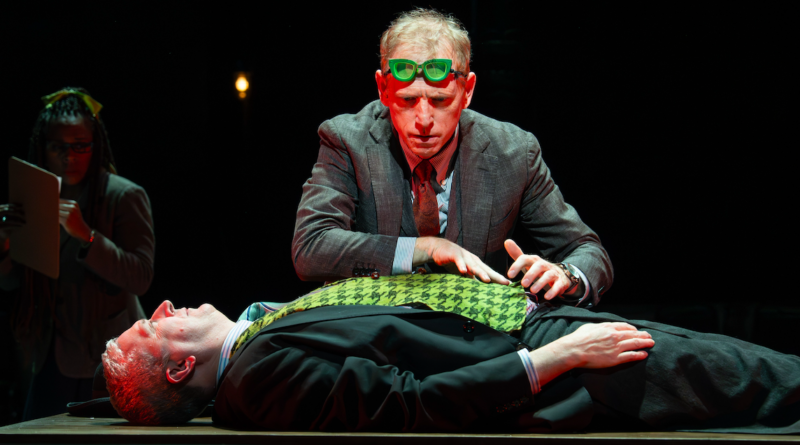
Photo: From left, Stephanie Weeks, Scott Shepherd and Vin Knight star in Ulysses. Photo courtesy of Joan Marcus / Provided by The Public Theater with permission.
It’s often written that James Joyce’s Ulysses is one of the toughest, yet rewarding, reads in literary history. Finishing the tome can be akin to completing a marathon, so one can appreciate the Herculean effort of the Elevator Repair Service, a theatrical company that has cornered the market on adapting great works of literature for the stage. They have brought Ulysses to the Under the Radar Festival, with performances continuing through March 1 at The Public Theater.
“That is exactly why we chose it,” director John Collins said about the challenges of the piece. “We have a few other projects that are adaptations of novels, and it’s an idea I like generally — working with literature and finding ways to use literature as it was written without adapting it or trying to fix it for the stage. But it’s important for me and for us as a company to give ourselves new challenges. I don’t want to ever be able to simply apply the same methodology or process or exact technique two times in a row because I fear, and I think I’m probably right, it wouldn’t be much fun. There wouldn’t be much discovery in it.”
Collins referenced Elevator Repair Service’s previous theatrical efforts, including the company’s landmark production of Gatz, which saw every word of F. Scott Fitzgerald’s The Great Gatsby play out over the course of more than seven hours. Ulysses is a much more manageable two hours and 45 minutes, featuring a condensed version of Joyce’s words.
The production began at Symphony Space a few years ago, and during the development phase, they quickly realized that the classic Irish text was too long to perform in its entirety. But they still wanted to create as complete a version as possible.
“I may have some ideas going in, but generally I like to start with an ensemble and then with that group of people find my way through the project,” he said. “So people aren’t being cast because I’ve got some types in mind and some sort of direction in mind. I find the direction with these people and let people gravitate toward what they are most comfortable with and what they do well. There’s a lot of trial and error. It demands a lot of patience from everybody and a lot of trust and good will, but I think in the end, if you can have that trust and that good will and that shared curiosity and that shared sense of humor, then you’re going to be on a road to discovering something. And that’s always most gratifying to me. It’s very much a collaborative project.”
Scott Shepherd acts in the piece, and he’s also billed as co-director and dramaturg for the production. Shepherd and Collins have worked together before, and there’s a mutual respect for how they approach the creative process.
“When we did Gatz,” Collins said, “Scott had such a tremendously important role as the narrator and central figure. He kind of became that close, trusted adviser to me on that and someone whose opinions and ideas I held in really high regard. He’s a very smart guy. We have been close friends for 30-plus years, and we know how each other’s brains work. It was a very natural choice. Scott is always incredible with text, whether it’s learning it, understanding how to speak it, the insatiable curiosity about where it comes from, how the writer thought, how the writer worked. We’ve had a relationship like this before, but this is the first time he’s had an official designated responsibility that way.”
Collins said he has always appreciated Joyce’s novel, which centers on a trio of characters living one day in the early 20th century in Dublin. But his understanding of its complexity only came after Elevator Repair Service sat down and dug in on this adaptation.
“I acquired that understanding through working on it,” the director said. “Fortunately I had Scott leading the way, always a step ahead of me on understanding what was going on, but again it was something that we talked through together. We were like a nine-person book club working our way through this, figuring it out. So, yeah, part of the reason that I think it’s good to do it that way, and I think this would probably be good for any book club really, is hearing these words out loud and understanding them spoken can take you a long way toward getting a sort of comfort with it.”
Collins added: “Yes, it’s famously difficult, and I understand why. … The narrative itself only lasts a day, but it’s like everything you could possibly imagine in that day. So I think of it as a kind of consciousness universe that you can go inside of. It is linear, for the most part, but it defies linear thinking in a way. I think it was one of the things we had to contend with to make it into a piece of theater because theater is essentially a linear experience. You go in at the beginning. You have an experience that lasts for a certain amount of time; you come out at the end. We did have to search for the connective tissues that do run throughout the book, so that was an interesting challenge for us. But I think the impression that I come away with in the book itself is not so much that it’s difficult; just that it’s immense. It’s a gigantic world that he’s made.”
By John Soltes / Publisher / John@HollywoodSoapbox.com
Ulysses, created by Elevator Repair Service and directed by John Collins, continues through March 1 at The Public Theater. Click here for more information and tickets.