
INTERVIEW: ‘Burn Book’ offers an alternative interpretation of ‘The Crucible’
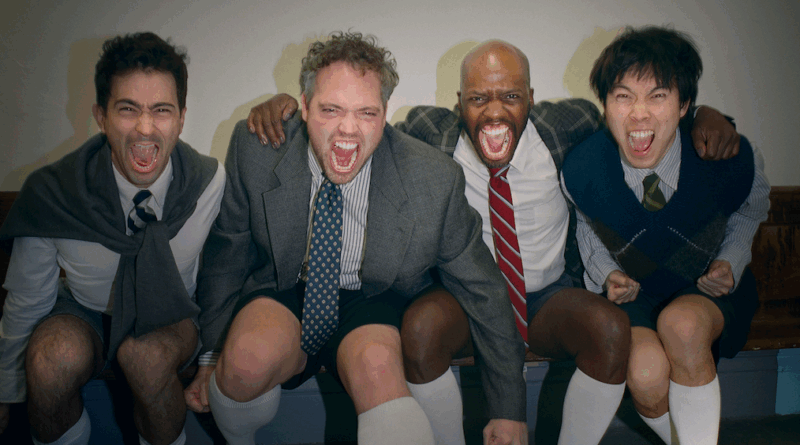
Photo: Burn Book reimagines The Crucible and sets the story at a boarding school in Massachusetts. Photo courtesy of Leaf Lieber / Provided by split/decision with permission.
When playwright JJ McGlone wanted to write a new version of The Crucible before the COVID-19 pandemic, he sat down and offered up some changes to the central story of Arthur Miller’s classic work. For starters, this Crucible is viewed through a “queer, pop-culture-infused lens.”
The play is billed as fanfiction, with the story now set at an elite boarding school in Massachusetts. The school is called Saint Vitus, according to press notes, and that’s where the audience finds the characters of William, Warren and Lewis — all three of them witches. They are gay friends who find friendship amongst themselves, but a new student, Ty, enters the narrative and may disrupt the social order of their inner-circle.
Recently Hollywood Soapbox exchanged emails with McGlone to learn more about the show, which is directed by Rory Pelsue and creatively produced by the split/decision theater company. Performances run through Friday, Nov. 14, at the 122 Community Center in Manhattan. Oh, and McGlone pulls double duty, acting in the piece as well.
Questions and answers have been slightly edited for style.
When did you first start working on Burn Book?
I wrote Burn Book in the fall of 2019. It was my third year of drama school at Yale, and it was programmed at the Yale Cabaret where it premiered on Halloween that year. This new production has been in the works since 2023.
What can audiences expect from this retelling of The Crucible?
Audiences can firstly expect to laugh and delight in nostalgia. Burn Book is a fanfiction; it mostly imagines the events that lead up to The Crucible if the young women of Arthur Miller’s Salem (Abigail Williams, Mercy Lewis, Mary Warren and Tituba) were four gay guys in high school in the mid aughts. The stakes are high, and the hemlines are higher. Burn Book is a campy examination of toxic queer relationships in adolescence. We want audiences to have a peek behind the curtain at the pathos that may lie beneath quippy cattiness.
The Crucible goes down as one of the most successful and respected plays in American history, but many people have problems with it, especially how it centers a man to tell a tragedy that mostly impacted women. What are your thoughts on the play’s legacy?
I think, as a brilliant classic, it stands the test of time and demands a multitude of interpretations and interrogations. That’s the delicious thing about drama — great plays are living documents; they are not fixed. Each generation of actors and audiences can wrestle with something new. I’m not a scholar on the subject. I just know that from a very young age I was mesmerized by what was happening to the young women in this play. Though they may not be the protagonists of Miller’s piece, they’ve left a lasting impression, and they are, in my humble opinion, the most enticing roles to embody.
Are they rotten bad seeds responsible for the deaths of innocent men and women? Are they victims of a patriarchal system that silenced and objectified them? Are they silly young girls dabbling with “magic,” frightened of the consequences? Are they bloodthirsty, vengeful beings who did dark dealings with the devil? Can they be all of these at once?
What I do know is that the story I am most interested in is theirs, and so I’ve written a fanfiction about them marrying my own experience growing up as a gay kid at boarding school heavily influenced by the millennial pop tropes of mean adolescent queen bees.
How are pop-culture references embedded within the work?
Well, I made sure I was “unafraid to reference or not reference.” We’ve got a handful of fun Easter eggs and parallels used in this dramatic decoupage — mostly in its structure. I’ve used the tried-and-true Hollywood formula of a group of three powerful insiders who are joined by a magnetic outsider who subverts the status quo. The Craft, Mean Girls, Heathers, Jawbreaker, Clockwatchers all share the exact same structure, which I hope will be delightfully recognizable.
I think the other way we indulge in reference is through behavior; these films and the indelible characters shaped how my friends and I and countless other “zillenials” navigated our adolescence. We were emulating these powerful girls, problematic as they may be. We were trying on how it felt to act like Regina George, or Veronica Sawyer, or Bonnie Harper and Rochelle Zimmerman, and the characters in Burn Book are doing the same. It aims to go a step beyond parody because it’s not only the actors mimicking these tropes; it is the boys in the play who are slipping in and out of behavior they’ve learned from their own digestion of pop culture.
What’s it like to work with Rory Pelsue?
It’s an absolute dream. He has cracked this play wide open. He’s such a brilliant thinker and fellow Salem Witch Trials nerd (we’re both from Massachussettes). He has the rare ability as a director to coax out nuanced and human performances while also achieving bold and stylized theatricality. It has been such a gift to finally work with him; I’ve been an unabashed fan girl of his work with Fake Friends — particularly their most recent Y2K epic musical The Last Bimbo of the Apocalypse — so to be collaborating with him both as a writer and actor is extra special.
Is there nervousness before you premiere a new production?
Of course! Are you kidding? I’m shaking in my boots! But I also have the utmost faith in this impeccable team, and our first run at the Yale Cab was quite a smash. So I hope it resonates with a New York audience. I’ve been having a blast bringing this to life again and seeing where it has matured as I have. It has been a true labor of love for every member of the cast and creative team. I pray that translates. It’s a vulnerable thing to make something and share it with strangers. But I’m an adrenaline junkie, so bring on the nerves! As above, so below.
By John Soltes / Publisher / John@HollywoodSoapbox.com
Burn Book, written by JJ McGlone, continues through Friday, Nov. 14, at the 122 Community Center in Manhattan. Click here for more information and tickets.