
INTERVIEW: Travel to New Mexico via a portal at Here Arts Center
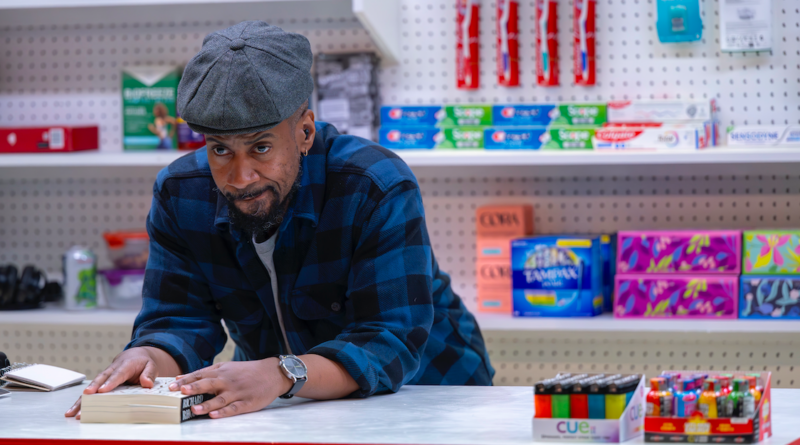
Photo: Entangled features Joshua David Robinson. Photo courtesy of Ashley Garrett / Provided by Emily Owens PR with permission.
The HERE Arts Center in New York City recently began performances of the new play Entangled: 12 Scenes in a Circle K off the I-40 in New Mexico, which must be in the running for one of the coolest and most descriptive titles of all time. The show comes to the Big Apple courtesy of writers Mona Mansour and Emily Zemba. Scott Illingworth directs the Society Theatre Company production.
In the play, the setting is — as promised — a gas station in New Mexico, but this is no ordinary gas station. It’s a strange place of time shifts and space shifts, where quantum science runs am according to press notes. Visitors should beware of the bathroom because some patrons never come back to the so-called real world. If the drama sounds abstract and even scary, don’t worry. There’s also a dance party and “micro emotional exchanges that may have epic implications.”
It’s safe to assume there’s nothing quite like Entangled, which continues March 28. Recently Hollywood Soapbox exchanged emails with Mansour and Zemba about the world-premiere show. Questions and answers have been slightly edited for style.
Is this based on an actual Circle K in New Mexico?
MANSOUR: Yes, I mean there are many in New Mexico, and for sure there are a couple in Los Alamos. One thing that came up in our development process, and later, as we talked to the designers, was that all of us who either had come from the West or who had at some point driven across the country understood that feeling of driving into the endless stretch of what seems like nothing. The way you’re forced into a very intense experience with the other person, or people — hours and hours of just you in the car, and then these places that have cold drinks and candy and chips, and whatever knick-knacks. It’s very visceral to me.
What exactly is this Circle K? Is it a portal to another dimension?
ZEMBA: This is a core question of the play — one that the characters ask and one we’ve asked ourselves a lot over the course of our workshops — ha. I will say, for me, it’s a place where science becomes tangible, somehow. It’s a place where time and space feel different. Our desert Circle K is kind of a liminal place — a place between places — and that liminality allows our characters to take actions and make decisions they maybe wouldn’t normally make.
Why 12 scenes? Why not 10 or 15? How did you settle on that number?
MANSOUR: Well, I think we had 14 maybe when we decided to give the play this subtitle, and A) it seemed likely we might lose a couple to rewrites, and B) who doesn’t like a dozen? The decision to basically telegraph that the play wasn’t going to be linear in a recognizable way — that there are these threads you follow, but they don’t necessarily intersect — came about after I was in Berlin for a week and got to see a few plays, and came back to New York all fired up about ways we could free ourselves from a more traditional structure. I think I pitched the idea to Emily at the 773 bar in our neighborhood, and she was game.
ZEMBA: I highly recommend making important artistic decisions in a bar.
How did the play get developed from ensemble research and debate?
ZEMBA: A lot of our play workshops were spent discussing materials and primary sources on this topic and then trying to activate those materials up on our feet. Actors improvised scene ideas, characters and physical moments based on prompts from us and our director, Scott Illingworth. Mona and I took tons of notes and videos from these workshops and then went away and wrote.
MANSOUR: There were all kinds of things that fed into the writing. One of the first workshops, we asked some of the actors to prepare real, live in-the-room science experiments. It was amazing — like most of us hadn’t done that kind of thing since junior high or so. I believe an earthworm got sliced in two, and there were gasps. There were heated discussions! For some people, science is next door to “energy,” which is next door to God. For others, God shouldn’t be brought up in the same breath as science. I think one universal thing was the realization that it’s very humbling, to realize there are these concepts that are frankly not easily graspable to most of us. A lot of that did end up in the play.
Did you study quantum science to better understand some of the issues brought up in the show?
ZEMBA: We absolutely did. We did collective research on quantum entanglement and related topics like free will (Do we have it? We’re not sure.). We also interviewed an actual cosmologist/particle physicist: Dan Hooper! The nature of quantum mechanics seems to be that the more you know about this particular field of science, the less you truly understand it, which was both super frustrating and kind of incredibly moving. It became more about the act of us trying to understand, of reaching for meaning, than actually coming to a conclusion.
Are world premieres scary? Exciting?
ZEMBA: I think world premieres are so exciting! It’s like proof of concept! Here’s the play! And we’re in great hands with our design team and Scott, who is an amazing director and synthesizer, and really trusting of things on the page that may not immediately be clear.
MANSOUR: Both! There’s something beautiful about knowing ‘none of this has been seen on any stage before.’ I think the whole ‘world-premiere’ thing is something we probably put a lot more stock in than a lot of audiences. They just want it to be compelling. They just want it to be good. They don’t all care as much as we do if someone’s seen it already.
By John Soltes / Publisher / John@HollywoodSoapbox.com
Entangled: 12 Scenes in a Circle K off the I-40 in New Mexico, written by Mona Mansour and Emily Zemba, continues through March 28 at the HERE Arts Center in New York City. Scott Illingworth directs the Society Theatre Company production. Click here for more information and tickets.