
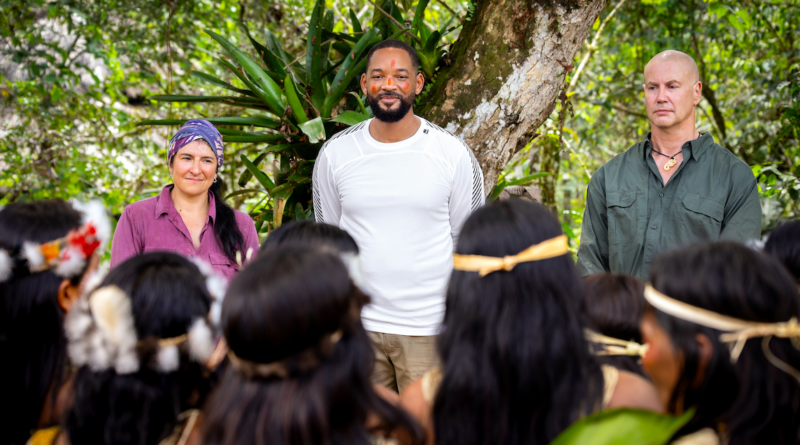
INTERVIEW: Bryan Fry travels with Will Smith to learn about anacondas
Photo: From left, expedition leader Carla Perez, Will Smith and Professor of Toxicology Bryan Fry meet the Waorani people in the Ecuadorian rainforest. Photo courtesy of National Geographic / Kyle Christy / Provided by press site with permission.
Bryan Fry, the so-called Venom Doc, is a professor of toxicology fascinated by the world of snakes, and his expertise is being utilized on the new National Geographic series Pole to Pole With Will Smith. On the show, Smith travels around the world for 100 days, throwing himself into numerous challenges and attempting to discover the wonders of the natural and human world, according to press notes.
Fry is featured on a couple of episodes, including one focused on anacondas, the enormous snakes that have captured the imaginations (and nightmares) of the public.
“I really like the format with Will being the bridge to a very different audience that I normally communicate to,” Fry said in a recent Zoom interview. “I’ve done a lot of docs. I’ve been featured in like over 200 so far, but most of them are the straight down the line, classic, natural world style. This is a very interesting format where Will is genuinely passionate about science and nature and has a real commitment to being an advocate for it. His daughter, Willow, has a big collection of boa constrictors. He’s used to having weird snakes around, so I learned as much from him as he did from me. I learned how to communicate to a much broader and more diverse audience then would normally be the case, and we were communicating some real world, high-impact stuff.”
Fry counts himself as a snake buff, and he has dedicated his entire professional life to better understanding these slithering creatures. Specifically for the show, the professor and expedition leader Carla Perez brought Smith to an Amazonian cave system to extract tarantula venom and learn more about big snakes. In another episode, he leads Smith to the ancestral lands of the Waorani to find the giant green anaconda.
“The broader impact was that this animal has a unique morphology,” Fry said about the anacondas. “The females are the giant leviathans you think of when you think of anacondas, 7-8 meters, 250 kilo, but the male of the northern green is unique. The northern green anaconda is different than all other anacondas in that there’s a huge sexual dimorphism, so the males are 2-2.5 meters, 15-20 kilos, and built like an eel. They’re completely different creatures, which means they’re feeding on completely different prey.”
Knowing this, Fry researched whether there would be distinct differences between the male and female specimens, given that they eat different critters and find themselves at opposite ends of the food chain.
“The hypothesis that I had was to show that ecological studies can have real world tangible human public health impacts because the idea was that the females are feeding at the bottom of the food chain, so feeding on deer and primary grazers,” he said. “So if a chemical is entered into the ecosystem, it’ll be at its lowest concentration in the females because they’re feeding on the animals that are eating the plants that just accumulated, but the males are feeding at the top of the food chain. They’re eating predatory fish like arowana and arapaima, turtles, caimans, frogs, so they’re a predator eating other vertebrate predators. So if a chemical enters the food chain being bioaccumulated and biomagnified through the various tropic levels, my hypothesis was it would be a much higher concentration in the males than females.”
Adding to his hypothesis is the fact that the Waorani don’t allow oil exploration on their lands, Fry said. The Indigenous community wants the area to remain pristine, but upriver from their land, as the series documents, are extractions of oil of varying sizes.
“[There have been] several catastrophic-level ones that have washed into the Waorani lands,” Fry said. “So the idea that I had was to use that sexual dimorphism as a tool and to test if there’s a difference in the petro-chemical accumulation into the tissues of females vs. males. Fortunately that’s exactly what we found. With oil spills, the danger is not just from the initial smothering of life from the oil itself, but the release of forever chemicals into the ecosystem, particularly ones like heavy metals like cadmium and lead, which decrease male fertility, decrease female fertility, cause damage to sperm, damage to the eggs, including the very DNA of the sperm and eggs, increase in miscarriage rates, increase in birth defects.”
His findings: “So the male anacondas have lead and cadmium at over 1,000 percent higher the concentration than the females, so this animal, while being cool from a scientific perspective as genetically distinct, the real impact was its use as a public health tool.”
By John Soltes / Publisher / John@HollywoodSoapbox.com
Pole to Pole With Will Smith is now airing on National Geographic, and available to stream on Disney+ and Hulu. Click here for more information.