
INTERVIEW: Talking Band heads to the countryside
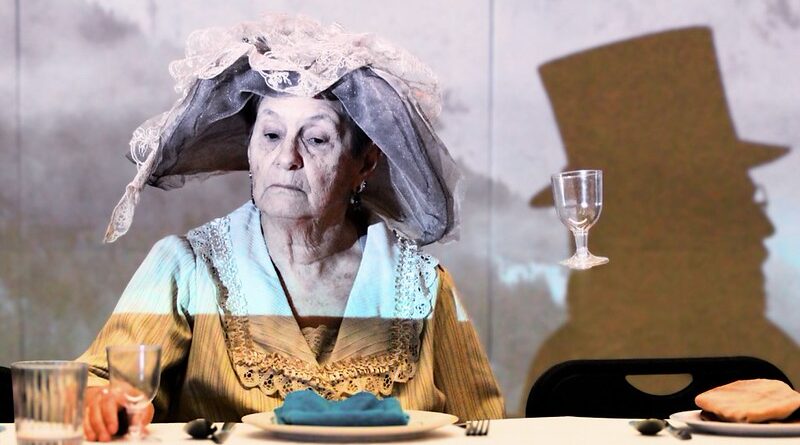
Photo: Talking Band’s The Door Slams, A Glass Trembles stars Ellen Maddow, who also wrote the music. Photo courtesy of David West / Provided by press rep with permission.
Talking Band is back with a new work called The Door Slams, A Glass Trembles, which continues through May 10 at La MaMa’s Downstairs Theater in New York City. The work, written and directed by Paul Zimet with music by Ellen Maddow, follows a couple who decides to move from the big city to the rural country, in hopes of getting away from the overwhelming political environment, according to press notes.
The play, influenced by Thomas Mann’s The Magic Mountain, has a lot of fun with timing, as the audience watches the characters over the course of a year.
To learn more about The Door Slams, A Glass Trembles, Zimet and Maddow exchanged emails with Hollywood Soapbox. Questions and answers have been slightly edited for style.
Have you ever thought about moving away from the city and starting anew in the country?
No. We try to spend several months during the summer in the country, when we write new shows and enjoy nature. But we are both city people. Paul is a native New Yorker, and Ellen is from L.A. But she’s lived in New York for over 59 years. We both thrive on the diversity and energy of the city, and its vibrant community of artists.
How much did Thomas Mann’s The Magic Mountain influence the development of the show?
Paul first read The Magic Mountain when he was 21 and the only passenger on a freighter crossing the Atlantic Ocean. The voyage took 14 days.The repetition of the days, the sameness of the sea mirrored for him the experience of patients in the tuberculosis sanatorium in the Swiss Alps where the novel is set.
In the novel Hans Castorp visits his cousin Joachim in a tuberculosis sanatorium in the Swiss Alps. He intends to stay for three weeks but discovers he too has tuberculosis and remains for seven years. The first 180 pages of the novel describe the first three weeks of his stay. Everything is new and strange to Hans. Then he settles into the routine of the sanatorium. Day after day, there are the same mealtimes, the same prescribed periods of exercise and periods of rest. As Joachim tells Hans, three weeks are the same as a day there. “Someone brings you your midday soup, the same soup they brought you yesterday and will bring again tomorrow.” Then, over the next 180 pages almost a year passes by. The reader’s sense of time expands and shrinks in the same way that it does for Hans.
In The Door Slams, A Glass Trembles a couple moves from the city to a rural home, hoping for respite from the political turmoil gripping the country. The play unfolds over the course of a year as their family and friends gather for dinners that repeat, fragment and morph into dinners in a sanatorium in the Alps. In the spirit of The Magic Mountain, time elongates; compresses; and layers events past, present and imagined.
How is music incorporated into the narrative?
Music in plays is often called “incidental music.” It’s there to provide an atmosphere, transition or punctuation to a scene. In the work of the Talking Band, music is intrinsic to the work. The musical score is woven into the fabric so that all the elements text, design, choreography are part of the music of the production. The meaning, humor and humanity of what the characters say and do is rooted in their melodies and rhythms.
How is the subject of “time” dealt with in the play?
In reading Thomas Mann’s The Magic Mountain, we experience the tension between our conflicting perceptions of time. We feel its elasticity — the way it can race by or feel interminable. In The Door Slams, A Glass Trembles, we want to enable the theater audience to experience the way the play’s characters are experiencing time’s disorienting malleability. The text layers past, present and imagined events. Tempos shift; some scenes loop back on themselves. The music and video strongly affect how the audience feels the movement of time.
Is the Talking Band process highly collaborative with the performers?
Although we generally write the plays, we draw inspiration from all our collaborators — designers, choreographers, musicians and performers. We developed The Door Slams, A Glass Trembles during a couple of residencies at the Mercury Store in Brooklyn. Within these workshops we were able to experiment with a group of actors. We began to develop the feel of the contemporary world of the play and the imagined world of an early-20th-century sanatorium in the Swiss Alps. We explored how the text worked in conjunction with the music, choreography and video to make the shifting movement of time palpable. The imagination and ideas of the actors will continue to influence the shape of the final work throughout the rehearsal period.
How is the play a commentary on today’s political times?
As we mentioned earlier, the context of the play is the present political turmoil. It is the background noise that at times comes into the foreground. We’re not interested in telling people what they already know about the political situation, but we are interested in examining how people live their lives in these times.
Talking Band has sometimes referred to itself as a poetic-political theater — poetic in its aesthetic, political in its content. Of course, all theater is political. It is either political by choice or by default. If the theater one creates merely reaffirms the status quo, then its absence of criticism, or interest in imagining alternatives, makes it unconsciously political.
By John Soltes / Publisher / John@HollywoodSoapbox.com
The Door Slams, A Glass Trembles by Talking Band continues through May 10 at La MaMa’s Downstairs Theater in New York City. Click here for more information and tickets.