
INTERVIEW: ‘Oklahoma Samovar’ is inspired by the playwright’s own family
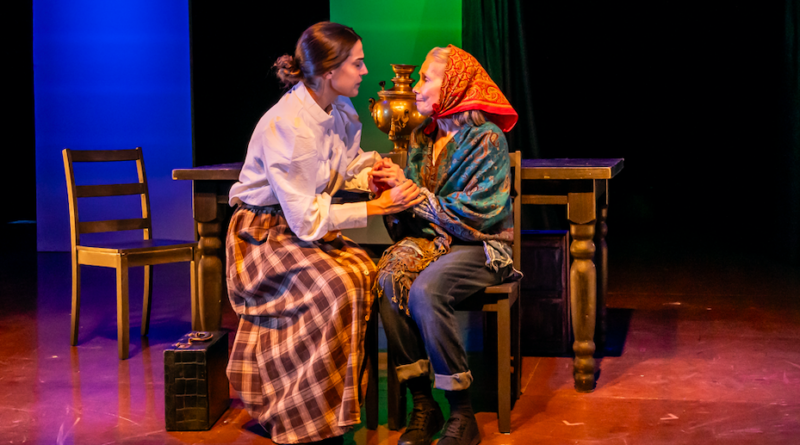
Photo: From left, Sarah Chalfie and Joyce Cohen star in Alice Eve Cohen’s Oklahoma Samovar. Photo courtesy of Marina Levitskaya-Khaldey / Provided by Everyman Agency with permission.
Alice Eve Cohen has recently been on a journey to better understand her own family’s connection to the so-called Oklahoma Land Run, a “land grab” that took place more than 125 years ago. Her new play, Oklahoma Samovar, is inspired by the story of her great-grandparents, believed to be the only Jewish participants in the Oklahoma Land Run of 1889.
The story depicted in the play starts a couple of years before the Land Run, with two Latvian teenagers fleeing Russia and landing in the prairie land of the United States, according to press notes. The audience simultaneously comes to learn of Emily, a 20-year-old living 100 years after the Land Run, who has been asked to spread her mother’s ashes on a farm in Oklahoma, and this modern-day character has no idea why such a request would be made. This opens up a time capsule for Emily as she begins to learn about her family and the difficulties they faced as Jewish immigrant to the United States in the late-19th century.
Oklahoma Samovar continues through Sunday, Dec. 21, at La MaMa’s Downstairs Theatre on the Lower East Side of Manhattan. The production, directed by Eric Nightengale, is a world premiere, but it has already met with acclaim. For the work, Cohen won the National Jewish Playwriting Contest in 2021.
Recently Hollywood Soapbox exchanged emails with Cohen to learn more about her family’s story. Over the years, her plays have been performed on the stages of the Kitchen Theatre, New Georges, New York Theatre Workshop, HERE Arts Center, Six Points Theatre and Cherry Lane Theatre, among others. Questions and answers have been slightly edited for style.
When did you first learn about this story about your ancestors?
I heard the family stories for the first time when I met my long-lost great aunt Sylvia in Oklahoma in 1987. She was 87 at the time. I was enthralled and inspired by her stories, which have inspired Oklahoma Samovar; a second play; and my memoir, The Year My Mother Came Back.
How would you say this story connects to life and issues in 2025?
The play is a unique example of the immigrant experience in America. My family’s journey speaks to how traditions and culture evolve differently, not only for my ancestors, but across all families and cultures. Past is present, and history repeats itself, for better or worse. What could be more current and connected to issues of 2025 than a story about the American immigrant experience in which dreams of reinvention collide with the demands of assimilation? My ancestors immigrated here to flee violence and persecution and find freedom. Today, immigrants come to this country for the same reasons, but instead of freedom, they are met here with anti-immigrant violence and persecution.
For those who might not know, could you describe the world of the Oklahoma Land Run?
In the play, the Land Run is dramatized on stage as a violent and chaotic land grab. In a later scene, it is transformed into an adventure story told by a father to entertain his little girls. I explore the contrasting ways the 1889 Oklahoma Land Run is depicted in history and in imagination, with romantic ideas of westward expansion covering up the moral ugliness underneath.
The first Oklahoma Land Run began at noon on April 22, 1889. Fifty-thousand people lined up at the starting line in hopes of racing to stake their claim to 160 acres of free land. Oklahoma Territory, previously called Indian Territory, was the land assigned decades earlier by the U.S. government to the Native peoples who were forcibly relocated from their ancestral homelands in the horrific Trail of Tears. The Native occupants of Indian Territory were tricked into giving up almost all their land, which was reassigned to settlers in the Land Runs.
What do you think your ancestors thought of the American Dream?
In the play, each of my Jewish immigrant ancestors has a different vision of the American Dream. I love exploring these contrasting dreams in the play. As an 18-year-old Latvian Jewish immigrant, Jake can’t wait to assimilate and leave his past behind to become fully American. Hattie’s American Dream is to keep her Jewish faith and traditions alive, even in the rural community where she and her family are the only Jews. The Giventer family’s American Dream is to escape the violence and antisemitism in Europe and find safety and freedom in their new home in Brooklyn.
Are you nervous before a world premiere?
Before a world premiere, I’m equally nervous and excited, bordering on terrified and ecstatic. Having a full production of Oklahoma Samovar, in collaboration with this brilliant company of theatre artists, is a dream come true.
What are your thoughts about premiering at the legendary La MaMa?
It means the world to me to premiere this play at La MaMa, a theatre I have loved for as long as I have loved theatre! I’ve seen countless shows at La MaMa, but this is the first time I’ve had a play presented here. I am profoundly grateful and honored to premiere Oklahoma Samovar at this beautiful and historic theatre.
By John Soltes / Publisher / John@HollywoodSoapbox.com
Oklahoma Samovar, written by Alice Eve Cohen, continues through Sunday, Dec. 21, at La MaMa’s Downstairs Theatre. Eric Nightengale directs the production. Livestream tickets are also available. Click here for more information and tickets.