
INTERVIEW: After six years, Brentano String Quartet returns to 92NY
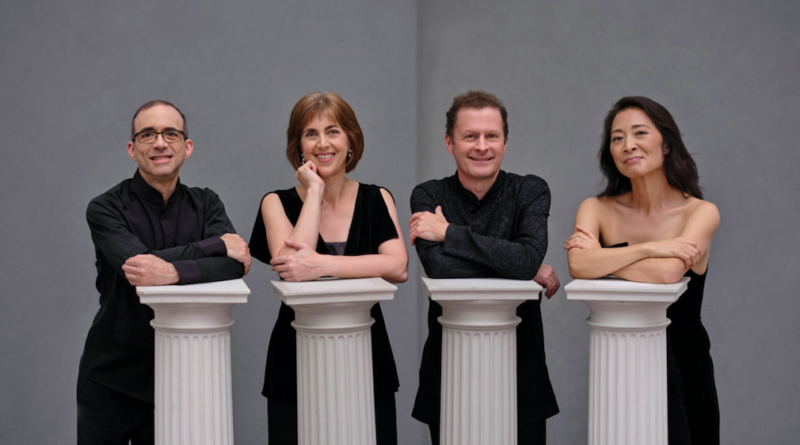
Photo: The Brentano String Quartet will play the 92nd Street Y on Wednesday, Dec. 10. Photo courtesy of J. Frank / Provided by Michelle Tabnick PR with permission.
On Wednesday, Dec. 10, New York audiences will have the chance to hear the chamber excellence of the Brentano String Quartet, a group that has been going strong for more than three decades. Mark Steinberg (violin), Serena Canin (violin), Misha Amory (viola) and Nina Lee (cello) have not played the 92nd Street Y in six years, but now they’re back with a program that will include Haydn’s “String Quartet in C Major,” Bartók’s “String Quartet No. 4” and Dvořák’s “String Quartet No. 13 in G Major.”
The Brentano String Quartet is perhaps best known as being artists-in-residence at the Yale School of Music; they also have close associations with the Norfolk Chamber Music Festival and Taos School of Music, according to their biography. They’ve just come off a tour of Spain, and they return to Europe in March 2026. Plus, they’ll make the 92NY something of a home over the next two seasons with an expansive Beethoven project.
Recently Hollywood Soapbox exchanged emails with the quartet to better understand their musical selections for the 92NY concert. Questions and answers have been slightly edited for style.
The upcoming program in New York City begins with Haydn and then jumps to a much more modern piece by Bartók. Do you like that juxtaposition?
Very much! Every Haydn quartet is extraordinary; he is endlessly inventive and dazzlingly imaginative, every work its own, newly discovered world. But even for Haydn, this particular quartet, “Op. 54 No. 2, in C Major,” sticks out as wildly iconoclastic. And one of the ways it which that manifests is in the inspiration of Romani improvisatory fiddling in the slow movement, which is a dark utterance festooned with florid ornamentation in the first violin, a visitation from eastern Europe, with the profound musical tradition of its nomadic peoples.
Then, of course, Bartók comes along, far later, and spends time studying the musical folk traditions of that region and imbibes them, taking them as the foundation of his own musical rhetoric in such a way that they become his native vernacular. The through-line continues in the folk-inflected Dvořák quartet on the second half of the program. All three works share some musical DNA, some common ancestry.
What do you like about the work of Bartók, specifically his “String Quartet No. 4”?
Bartók’s quartets are a justly treasured gift to string quartets (and their audiences!), inviting the medium that had served great composers since Haydn into new, previously uncharted territory as regards sonority and rhetoric derived from folk traditions that had for earlier composers been used more often as an exoticism than as an essential fount of meaning.
Of all his quartets, the fourth is probably the most accessible, with the clarity of its motivic cohesion; its driving, often propulsive, rhythmic energy; and entrancingly evocative extremes of texture and color. The piece is written in a so-called “arch” form, where the outer movements are variations of each other, sharing musical material, and likewise the second and fourth movements, one hushed and furtive, the other teasing and playfully dispensing with the bows for an entirely plucked texture.
The central movement is a deeply felt and mysterious lament, full of the characteristic rhythmic linguistic signature of Hungarian, a short accented syllable plus a long, unaccented rebound note. It speaks (in Hungarian) directly to the heart (even to non-native speakers!).
How are the acoustics in the Kaufmann Concert Hall at 92NY?
We love the Kaufmann Concert Hall! Largely because of the great tradition of innovation and excellence it represents across multiple art forms, and also in large part due to the truly visionary and kind, supportive people who work there. But certainly also the hall itself. It feels rather surprisingly intimate for a hall of that size, and the sound is very honest: clear and direct, with just enough ambiance to give that little extra bit of life without obscuring any details or subtleties.
Have you always played these instruments, ever since you were a child? Or did you try different non-string instruments first?
Some of us in the quartet have dabbled in keyboard instruments. A couple of us had brief flirtations with the clarinet, and, as is not atypical, Misha, our violist, started life as a violinist before he saw the light! But by and large I wouldn’t wish on anyone having to hear us play other instruments!
Are you nostalgic about your past, or do you always like to look forward? Can you believe it has been more than 30 years?
We have so many fond memories of the past three decades, which sometimes feel like an eternity, and, at others, like the merest moment. We certainly get nostalgic from time to time, and it is a real privilege to have a long and beautiful history engaging with each other, with audiences all over, and with the always challenging and meaningful scores we play.
We were at a huge quartet festival recently with quartets from all over the world, and were startled to realize we were the oldest quartet there! We remember as if it were yesterday always being the youngest group everywhere we went. I can’t be sure about this, but I believe we may be the group with the same four players for the longest of any quartet currently playing, anywhere. We’re hoping for many more years of that! (And, as a side note, if you enjoy nostalgia from time to time, the Dvořák quartet we’re playing is filled with it in the most loving and tender way.)
What inspired you to call yourself the Brentano String Quartet?
Joking about names for a group is fun and easy; actually coming up with a good one, less so. We are forever indebted to Thomas Sauer, brilliant pianist and also husband of our second violinist, for naming us.
Beethoven, of course a central preoccupation for any string quartet interested in the standard repertoire (do come back to 92NY to hear us play his complete quartets over the next two seasons!), wrote a love confession addressed to his “immortal beloved,” the identity of whom has long been a source of conjecture for musicologists.
One of Beethoven’s important biographers, Maynard Solomon, believed her to be Antonie Brentano. We actually had occasion to meet Solomon at a function at Sotheby’s celebrating the discovery of the manuscript of the piano four-hands arrangement that Beethoven did of his Grosse Fuge (originally for quartet), which we had played, in the original version, there. I recognized him only from having seen his picture in his books, and he came to me with a big smile, without introducing himself, and shook my hand, saying, “I believe I had something to do with your name!” To which I replied, simply, “Yes — thank you, Mr. Solomon.”
By John Soltes / Publisher / John@HollywoodSoapbox.com
The Brentano String Quartet will play the 92nd Street Y in New York on Wednesday, Dec. 10. Click here for more information and tickets.