INTERVIEW: Human Rights Art Fest returns to NYC
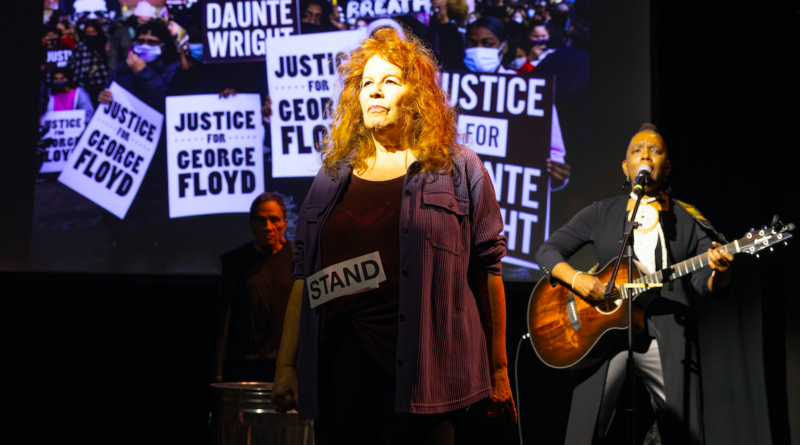
Photo: Lindsey Wilson and the Human Hearts Trio perform at last year’s International Human Rights Art Festival. Photo courtesy of the artist / Provided by Emily Owens PR with permission.
The International Human Rights Art Festival, featuring a wide variety of discussions, showcases and events, returns to New York City, Dec. 8-14, at The Tank in Midtown Manhattan. This is the seventh time founding executive director Tom Block has gathered artists and activists together to comment upon and investigate the need for human rights around the globe.
This year’s offerings have many different dimensions and qualities. For example, on Dec. 9, one can enjoy Celebration of Women’s Power; the next night there’s a Celebration of LGBTQIA+. Artists for these two evenings include Valkyrie Yao, Alyssa Borelli, Leif Larson, Jo Ratnik and Colleen Morgen, among others.
WADE Dance will curate a performance called We Wear the Sky, which is centered on “boundless identity, personal freedom and collective pride.” There are also events on immigration, climate change, gender, sexuality, Queerness and protest.
To learn more about the 2025 edition of the International Human Rights Art Festival, Hollywood Soapbox exchanged emails with Block. Questions and answers have been slightly edited for style and brevity.
What sets this year’s International Human Rights Art Festival apart from previous versions?
The United States has gone through — is going through — a stress test to our democracy unlike anything we have experienced in more than 150 years. Our organization (International Human Rights Art Movement, presenter of the International Human Rights Art Festival) has leaned into this moment, standing firm for the values that we believed “made America great”: human rights and social justice, equally for all; open arms for the world’s “tired, poor, and huddled masses yearning to breathe free” (inscription on the Statue of Liberty); and an economy that works for everyone.
However, what we have learned is that the institutions that we thought helped safeguard these ideals are paper thin, folding almost immediately before the recent onslaught of authoritarian energy. Politicians, educational institutions, media, law firms, the Supreme Court — all appeared to be more beholden to this current regime, rather than the ideals we always felt held us, as a nation, together and made us unique in the world.
We — at the International Human Rights Art Festival — know that when all other institutions fail, artists will always stand on principle, often at great personal risk. We know this because we work with artists around the world who risk their livelihood, their homes, their safety and sometimes even their life to write a poem or sing a song, speaking truth to power. We made a decision at the beginning of this administrative onslaught to stand with these international brothers and sisters for the ideals which make us most human. We did so understanding that if things continued in the direction they were going this past spring, we could face truly dire consequences. One thing we have learned is that no dissent is too small for a successful authoritarian regime to crush. And as an aggregator, supporter and disseminator of activist art energy, we are hardly the smallest oppositional voice in the land.
So, this year’s festival takes place just after our publishing America’s Slide Toward Authoritarianism, just in advance of our publishing Voices of Palestine, and at a time when our democracy, freedom and way of life feels as threatened as I can remember in the term of my increasingly long life.
How is this festival truly international?
We are international in a couple of ways. We work with New York-based artists from around the world — this year, 250+ creators from 26 countries and 19 U.S. states. … Additionally, we make certain to continue drawing the circle closer with our international artists (we have worked with artists from 117 countries; have three African offices — Zimbabwe, Nigeria, Cameroon — and are in discussions with co-producers to bring our performance festival to Scotland, Kenya, Bangladesh, Nepal and Tunisia, funding dependent, of course) by showing the winners and honorable mentions from our African Human Rights Spoken Word contest (visit the page and scroll down to see the winners).
We also highlight specific stories of artists at risk … who we support in a variety of manners (making contacts with other legal and activist organizations, writing letters of support, sending direct action grants, etc.), using the energy and interest generated in our signature, in-person annual festival, to connect with art-activists from such places as Afghanistan, Morocco, Uganda, Yemen, Iran and other places, creating an international community of art and heart. I share some of the stories from our international art activist brothers and sisters in the pre-show announcement, helping our audience and artists appreciate how vital our work is in an international context, and how fragile our freedoms can be.
Would you call this activist or advocacy art?
I would call this work more “activist” art — as in activating positive energies and supporting the struggle for the values which we hold dear, and which feel so frail at this time. The values of our organization (celebrating diversity; engagement with all members of society; sincerity and vulnerability of presentation; and beauty as a fundamental creative value) underpin all of the work we present. We ask that all social and political issues addressed by our artists are addressed within this lens. We do not present work that distills anger or involves finger pointing at an “other” — regardless of how righteous the anger — if it inspires negative or hurtful energy.
I believe that the strongest manner of affecting an audience — instead of simply separating them into those who agree with a position from those who disagree — is to tell stories from a personal point of view with beauty as the frame. Everyone can relate to such a message and not be forced to “choose sides.” Our audiences learn, grow, understand and even develop empathy, as everyone in their life has felt wronged, overlooked, disrespected etc. Empathy, rather even than sympathy (understanding intellectually without sharing the emotional impact), is the basis for true change — personal and societal.
Within this framing, we definitely support advocates — that is to say, many if not most of our artists are advocates for a specific issue — be it child marriage in Nepal, violence against women in Africa, Black Lives Matter in the United States, immigrant issues in Europe, freedom of speech in China or Russia, the climate catastrophe in Bangladesh, etc. However, to advocate for their concern, their work must respect and hew to our value system.
You have a program called Protest, Passion, Power. Could you describe what these three terms mean to you?
We created this new performance block around these ideas this year because we wanted to highlight the more general solidarity that activists share across all advocacy issues. The same positive energy and opening to understanding must be created, whether talking about climate change, Palestinian rights or the rights of girl-child education, or any other concern.
So, we wanted to highlight this shared, positive and shape-changing energy at the heart of all our — and all successful — activist artwork and advocacy in general.
And to clarify, we support work that uses our value system to challenge the status quo (“protest”), do so with the “passion” of true commitment, and understands how these energies might be brought together to generate true social “power,” in terms of changing society and politics for the better. Power of this sort is gentle, infiltrative, nonviolent, and with the strength (fueled by the passion of the creator) of a diamond, the hardest natural substance.
How does the festival promote LGBTQIA+ rights?
First of all, it is important to note that we do not separate specific advocacy issues into those which are more important or less important than others. However, we take this particular issue extremely seriously — especially in light of the political moment, where anti-Trans and anti-LGBTQIA+ laws and sentiment around the United States and throughout the world is as high as it’s been in decades.
We have done tremendous work throughout our history in support of the LGBTQIA+ community, including publishing Queer Voices of the World: Stories, Poems, and Essays Responding to Worldwide LGBTQ+ Criminalization in 2023; presenting performance blocks around Trans and LGBTQIA+ experience at all of our festivals; working closely with Thank You for Coming Out improv group over the years; had our work banned by the Catholic Church due to our LGBTQIA+ content and support; and much other work.
This year, we include a full LGBTQIA+ performance block, with theater and dance, on Wednesday, Dec. 10 at 7 p.m., as well as presenting Trans and LGBTQIA+ artists and performances during our Ten Minute Play Festival (Monday, Dec. 8, 7 p.m.), We Wear the Sky (Wednesday, Dec. 10, 8:30 p.m.), MARE NOSTRUM ELEMENTS (MNE) Gender, Sexuality, and Queerness through the Dancing Body (Saturday, Dec. 13, 3 p.m.), Celebration of Human Rights (Saturday, Dec. 13, 7 p.m.), and the Short Performance Festival (Sunday, Dec. 14, 7 p.m.).
By John Soltes / Publisher / John@HollywoodSoapbox.com
The International Human Rights Art Festival runs Dec. 8-14 at The Tank in New York City. Click here for more information and tickets.