
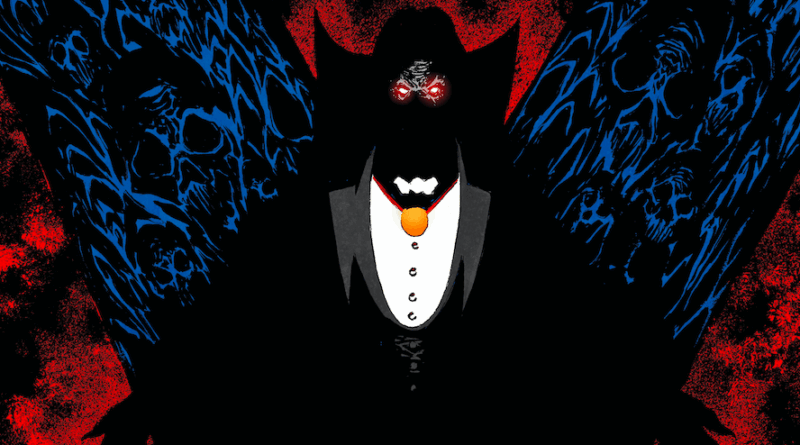
INTERVIEW: Secret history of Dracula continues with a third bloody volume
Image courtesy of Dark Horse / Provided with permission.
Matt Wagner and Kelley Jones have built impressive careers in the comic space, and one of their crowning achievements is a series of graphic novels centered on the character of Dracula. Now the creative duo is fundraising for Dracula: Book III — The Count, a continuation of the storyline, courtesy of Dark Horse. Pledges are currently being accepted via Kickstarter.
This time around, The Count focuses on Dracula’s point of view, so readers should expect similar events as the original tale, but with many blanks filled in along the way. Fan will enjoy 120 pages of content, all wrapped together in a large hardcover edition. Jones takes care of the art, while Wagner serves as the writer.
Recently Hollywood Soapbox exchanged emails with the two creatives to learn more about the Kickstarter campaign and their fascination with the Dracula legend. Questions and answers have been slightly edited for style.
How is Book Three: The Count different from the previous two installments?
WAGNER: In many ways, this volume is the one we’ve been working towards since the entire project began several years ago. This book is one of the most intensive things I’ve ever written because it takes place at the same time as Bram Stoker’s classic 1987 novel, yet it’s from an entirely different perspective.
Dracula is not only one of the most famous books in the English language, it’s also one of the most analyzed, annotated and scrutinized. Every action in the novel is noted and set within a very specific calendar. As such, I had to make sure that this volume of our saga not only met its inevitable taste test by all the world’s Dracula scholars, both lettered as well as amateur, but it also had to present an exciting and engaging story for those who’ve never read the novel.
Dracula himself is largely offstage for most of the novel once the action moves to London, but he’s definitely doing something while he’s there. His schemes are certainly sinister, but he’s also tactically cautious, not only from his years as a military leader but also from his hundreds of years of existence as a vampire, wherein a variety of different criteria that are insignificant to humans might prove devastatingly fatal to him. Our setting is utterly different this time around as he now roams through the crowded streets and houses of one of the world’s largest metropolitan cities at that point as opposed to the rustic and desolate highlands that had been his hunting grounds for centuries. He’s out of his element here and trying to both explore and exploit his new home to best benefit his nefarious desires.
And Kelley’s art — as absolutely incredible as it was in both Books I and II — is a level beyond even those achievements. His art is so very evocative of that era, and I was just telling him the other day that there’s a level of focus and intimacy this time around that surpasses anything I’ve ever seen him do before. It’s no exaggeration to say that these are the books that Kelley Jones was born to draw.
JONES: Book III is a totally different atmosphere due to the fact Dracula’s in London and not a wilderness province of a rustic backward country. The pacing is faster as well matching a modern city with its brisk pace. He loves it. He sees whole new worlds to conquer, and that makes my drawing evolve with the events. Everything will hurt more.
Is Book III done and ready to ship, or are you still working on it?
WAGNER: Each of the books has been produced in pretty much the same fashion; the script is written early on, and the majority of the artwork is done by the time each Kickstarter campaign launches in October (Dracula season). The final artwork, coloring and lettering then usually wrap up around the end of the year, and the overall book design and production is in gear by that point as well. The books then head out to the printer at the beginning of the spring months, and the printing process begins. The print run ships from the printer at the end of summer and heads to our fulfillment service, which processes the orders and ships all copies to the campaign’s many backers. The backers then receive their copies sometime in September, just in time to read and enjoy their purchases right as the crowdfunding campaign for the next volume is set to launch again in October. It’s been a well-oiled and successful process so far, and we plan to keep it rolling exactly the same from volume to volume.
JONES: It’s almost all done. This is a blast to draw, and I want to see it finished more than anyone else. There is a great satisfaction delivering crowdfunded books on time!
Why do you think Count Dracula is largely unseen once Bram Stoker’s original novel heads to England?
WAGNER: The novel is very Victorian in almost every way, in its morality, in its fear of “otherness” and in its portrayal of sex — shown in this case by the penetration of the flesh by fangs and the exchange of bodily fluids via vampiric attack — corrupting otherwise “pure” women. The book is also considered one of the most successful examples of an epistolary novel, meaning there is no omniscient account of the action, and the narrative is told solely in the form of personal letters and private journals and such. All of that serves to develop an intimacy and an immediacy among the heroic characters, and leaving Dracula out of the main onstage action after his dramatic appearance towards the beginning of the novel absolutely serves to strengthen his unseen presence as a sinister threat.
Once the setting shifts from Dracula’s castle in Transylvania to the fog-enshrouded streets of London, Dracula is offstage for the most part, and that definitely works in the novel’s favor. It presents him as more of a supernatural entity rather than a physical villain, and that accentuates the terror of his danger. But, after 120+ years of this classic novel infiltrating the popular zeitgeist and forging an incredibly deep cultural resonance — I maintain that Dracula is the most famous literary character of all time — we thought it was time to not only unveil what he was doing during his time in London but also to hear the Devil’s story from his own mouth. The only voice missing from Stoker’s epistolary masterpiece is Dracula himself! Our epic series puts Dracula front and center for the entire narrative and features his own accounts of his entire blood-soaked history and beyond!
Is your Count Dracula sexy, mysterious, regal, all of the above?
WAGNER: Yes, he’s all of the above, and he’s absolutely monstrous within each of those descriptions. Dracula is a creature of lust; he lusts for power, he lusts for dominion and he lusts for blood. And it’s only the latter aspect that is a direct and literal result of his vampirism.
He was always fairly blood-thirsty, and that horrible trait along with all of his other megalomaniacal desires were firmly developed when he was still a Wallachian Voivode (warlord/prince) during which time he ruthlessly condemned tens of thousands of people to living impalement as a form of execution and intimidation.
One characteristic he definitely doesn’t embody is romance. So many film versions of the character and the novel — most notably Francis Ford Coppola’s flawed but brilliantly made 1992 version — present and focus on Dracula as being romantically drawn to one or the other of the novel’s two main female characters, Lucy Westenra and Mina Murray Harker (which varies from film to film), even going so far as considering them to be the reincarnation of his long lost lover or wife. Absolutely none of that is present in the original novel. He preys on Lucy because she’s the first person he encounters after the Demeter, the ship carrying his precious 50 crates of Transylvanian soil, crashes near Whitby on the northeastern coast of Britain. And he later preys on Mina sheerly to weaponize her against his enemies.
There’s nothing redeeming about Dracula from a humanistic sense, and yet we’re fascinated by him all the same. I created the comic Grendel over 40 years ago, so I’ve got some firmly established experience with writing charismatic, unrepentant villains. But these sort of characters permeate many forms of popular culture. Think of Hannibal Lecter or Tony Soprano. They’re both a dark beacon and a dark reflection of our own less-than-noble desires.
JONES: My Dracula is all those things, and yet his desires are always in how he looks and how he walks in the world that is of a predator.
What is the reason for the enduring interest in vampire lore?
WAGNER: It’s because those lusts that I mentioned earlier are an eternal aspect of human existence. And, holy shit, we’re living in an age of vampires right now, aren’t we? Look around. The world stage is dominated by megalomaniacal aristocrats (businessmen in our modern sense, as opposed to royalty) who seem to have no moral compass other than their deep-rooted desires to consume more and amass more power, influence and insulation from the real world’s problems.
They live in modern castles, and you can almost imagine them sleeping in some sort of sarcophagal pods that protect them from any outside threat. And most of them also seem to wield some sort of hypnotic power over the masses, a vile glamour that suckers in millions of people and makes them ignore the blatant corruption on full display and in the most garish audacity. The dark side of any mythology — what in the modern era is horror literature — serves to codify and help us deal with the threats and fears that assail us every day. These days, that function is more vital than ever! To quote Elvis Costello (actually, Nick Lowe): “So, where are the strong? And who are the trusted?”
JONES: To live forever. To live by night. To live by your own desires. That’s interesting stuff.
Is it fun to illustrate and bring to life this historical time period?
WAGNER: Hell, yes! Creators love working in the high points of any civilization, and for western culture, that has some definite touchstones. Whether it’s the ancient Egyptian culture or the classical Greco-Roman era, the rough- hewn Medieval period, these sorts of settings and societies present a rich and fruitful tableau in which to tell stories. In the more modern era, this sort of canvas is found in 20th century America and the Victorian era. Both were pinnacles of human endeavor in their various time periods, and yet they were also both the home and the breeding ground for spiraling madness and homicide. Like I said, it’s a deep well from which to draw tales that resonate and reflect.
JONES: It is an undiscovered country to explore if you, without any modern convention and without bias, present those eras and worlds. That angle adds so much to the story I tell.
By John Soltes / Publisher / John@HollywoodSoapbox.com
Dracula: Book III — The Count, written by Matt Wagner with art by Kelley Jones, is now accepting pledges via Kickstarter. Click here for more information.