
INTERVIEW: Guy Pearce on the characters that most interest him
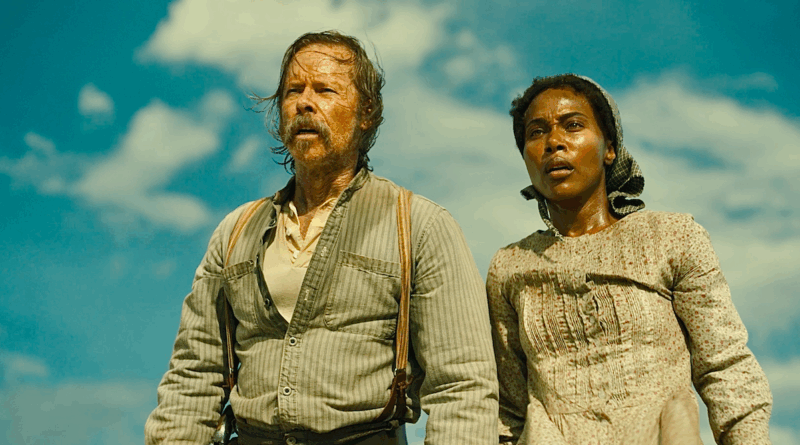
Photo: Killing Faith features Guy Pearce and DeWanda Wise. Photo courtesy of Shout! Studios, A Radial Entertainment Company / Provided with permission.
Guy Pearce, the accomplished actor of The Brutalist, L.A. Confidential, Memento and Alien: Covenant fame, is back in cinemas with the new Ned Crowley-directed movie Killing Faith, which finds the actor playing the character of Dr. Steelbender, a troubled, ether-addicted doctor in mid-19th century Arizona territory. In the film, the doctor teams up with Sarah (DeWanda Wise), who used to be enslaved, and her young daughter (Emily Ford) in order to find a supposed healer by the name of Preacher Ross (Bill Pullman), according to press notes.
“I liked the extremities and the turmoil that he’s completely consumed by, and at the same time, his ability to deny it and try to bury his head in the sand I thought was fascinating and quite funny,” Pearce said in a recent Zoom interview. “So there was a lot going on. It felt authentic on the page. He felt like a very extreme, troubled, slightly pathetic human being who didn’t know if he was ambitious or if he had a death wish. He really didn’t know if he was a good person or a bad person, or what he was doing, and so this opportunity that falls into his lap of going on a journey with DeWanda’s character, I thought that Steelbender sees this as a calling, some type of calling, even though he was cynical about who they were going to see.”
One interesting complication in the movie is that this is not a typical western flick. As audiences come to learn, Sarah’s daughter may have special, supernatural powers. Everything she touches dies, which means she’s more feared than the outlaws of the American West.
“I think he’s got a lot to learn about himself, and DeWanda, her character really enables that,” Pearce said. “There’s a connection obviously between the two of them. The other interesting thing, too, is the question of whether there possibly could have been a love story between the two of them. Even though that’s somewhat laughable, I suppose, because he’s such a f—up, for want of a better expression, the question would have at least been in his mind, I think.”
Pearce talked about scenes where his character and Sarah are sleeping next to each other in the great wide open of the Arizona territory, and one can almost sense the questions running through Steelbender’s mind: Is she interested in me? Am I interested in her?
“All that noise would have been going on in his head,” he said. “You would hope that perhaps the audience might ask that question, too, even if everybody comes to the conclusion that she needs to find somebody far more worthy than him. I like the idea that the question perhaps might have been there.”
For Pearce, an actor who has performed in everything from The Last Vermeer to Iron Man 3, he’s been on a career-long journey to add subtext into each character that he portrays. He said a lot of this behind-the-scenes work ultimately lands on the cutting-room floor, but he sees value in the technique.
“One of the difficulties that I think all of us actors face — and this a first-world problem, so I’m not complaining — is that we’re always trying to inject importance into the characters we play,” he said. “We’re trying to inject three dimensions and make them fully-rounded human beings, and quite often, if that’s not there on the page, in the end the stuff that we inject into the character will end up on the cutting-room floor anyway because it’s not what the film’s about. You’re there to serve a purpose. You’re there to facilitate what the plot is, and, of course, we want to make all of our characters rounded, three-dimensional human beings. And we do the best we can in that.”
Pearce said actors often develop imagined pasts to help them better play the role, and even though much of that work doesn’t make the final cut, the performance is aided by them figuring out who these people truly are.
“If the film is about people, and it’s about interaction, and it’s about the dilemmas that these people are in in their lives, then inherently the three-dimensional nature of those characters ends up in the movie because that’s what the film is about,” Pearce said. “It’s an exploration of the human condition and the human psychology, etc., even if there is a plot that’s driving it forward. So to find scripts that gets its claws into human nature, they’re the scripts I’m interested in because #1 it ends up in the movie and #2 it’s just the stuff that I want to delve into myself. I’m not interested in bells and whistles and explosions and exciting stuff for an audience to watch because it’s exciting stuff. I’m just interested in the people that are in the story.”
Pearce added: “I’m interested in the story as well, but it’s got to be about the people. And when that stuff exists in the characters, and you can tell that the writer-director that’s what they’re focusing on, then you feel like you’re in good hands. And you feel like you’re doing something that is being listened to and being observed, and then I can give back. And I can give the film what I think the script is asking for.”
By John Soltes / Publisher / John@HollywoodSoapbox.com
Killing Faith, starring Guy Pearce, is now playing in movie theaters. Click here for more information.